Drop Shipping Advertising: Channels, Margins and Testing
November 8, 2026
Say you've marked up a product by $15, your supplier needs 15 days to deliver it, and you start buying ads immediately. A few orders arrive, then sales flatten while spending keeps climbing. Your advertising dashboard shows revenue, but your bank balance doesn't look healthier.
The next move isn't necessarily a new campaign. Before paying for more visitors, you need to know what you can afford to spend on a customer and whether that customer can trust what you're promising.
Table of Contents
- Why Drop Shipping Advertising Is a Different Game
- Margin Math to Run Before the First Click
- Choosing Channels Based on Buyer Intent
- How to Test Creatives Without Burning Budget
- Trust Signals That Protect Conversion and Accounts
- Reading Competitor Activity Signals Over Time
- Set Your Test Budget and Confirm the Plan
Why Drop Shipping Advertising Is a Different Game
Drop shipping advertising means paying to promote products you don't stock yourself, with a third-party supplier handling fulfillment. You control the advertisement, storefront, and customer relationship, but you might not control the parcel that determines whether the buyer stays satisfied.
That separation creates a harder buying decision than a campaign dashboard suggests. In the hypothetical store above, the product markup isn't available entirely for advertising. The seller still has to cover fulfillment costs, transaction expenses, and the cost of resolving orders that go wrong.
The pressures behind each sale
- Thin spending room. Supplier shipping, payment processing, discounts, and platform fees reduce what's left to acquire a buyer. A product can have an appealing markup and still be unsuitable for paid traffic.
- Delivery uncertainty. Customers judge your promise, not your supplier's explanation. If an order arrives later than expected, you're the person answering the refund request.
- Interchangeable products. Other stores may sell the same catalogue item using similar photographs. Without a distinct demonstration, offer, or service promise, buyers have little reason to choose yours.
The surrounding advertising market is enormous. According to SaleHoo's digital advertising report, digital channels represented 72.7% of nearly US$1.1 trillion in global advertising investment in 2024. That establishes the scale of the environment, not the profitability of dropshipping within it.
Buying access to shoppers is straightforward. Buying customers at a cost your business can support is the actual job.
A useful campaign decision therefore starts outside Ads Manager. You need an affordable acquisition cost, a believable product promise, and a way to distinguish a promising test from expensive activity.
Channel selection, creative experiments, competitor monitoring, and budget decisions become easier once those conditions are clear. Otherwise, switching platforms merely changes where you lose money.
Margin Math to Run Before the First Click
Suppose your store has a $60 average order value and a 30% contribution margin before advertising. Those hypothetical inputs leave $18 per order available for acquisition before the order's contribution falls to zero.
That doesn't mean you should target an acquisition cost of $18. It means spending that amount leaves nothing from the order to cover fixed overhead or profit.
Calculate what an order actually contributes
Use this worksheet structure:
Contribution before advertising = net sales revenue − product cost − supplier shipping − payment fees − variable platform fees − expected refund and chargeback costs
Then divide the contribution by net sales revenue to express it as a percentage. Keep sales taxes collected for remittance out of revenue, and avoid deducting the same refund loss both from revenue and from your cost allowance.
Use an expense worksheet before choosing campaign targets.
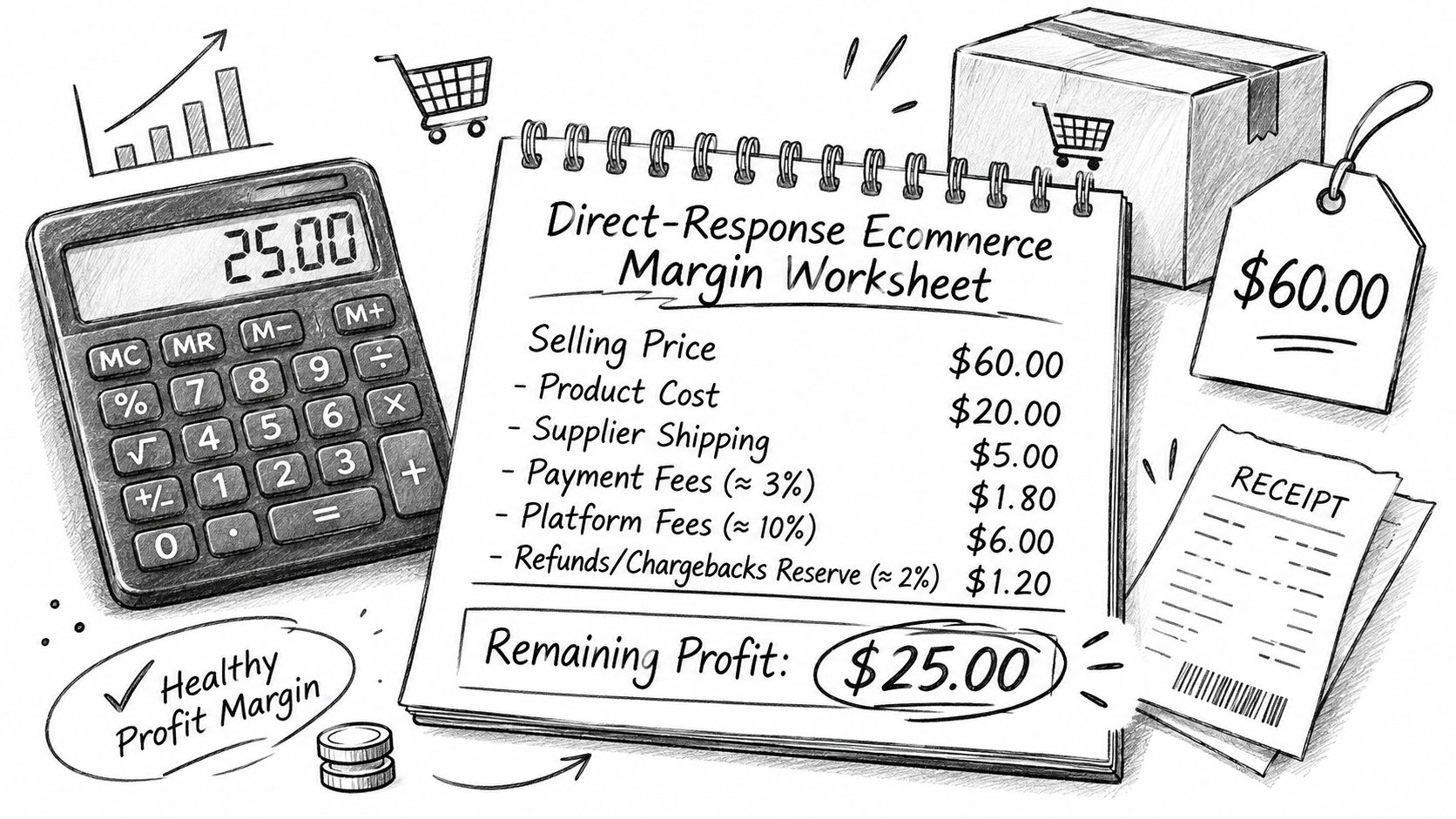
The following table is a hypothetical calculation, not an industry benchmark. Every acquisition ceiling is the stated margin multiplied by the assumed order value.
Break-even ROAS and maximum acquisition cost by margin
| Contribution margin | Break-even ROAS | Max acquisition cost at $60 order |
|---|---|---|
| 20% | 5.00 | $12 |
| 30% | 3.33 | $18 |
| 40% | 2.50 | $24 |
| 50% | 2.00 | $30 |
| 60% | 1.67 | $36 |
Break-even ROAS = 1 ÷ contribution margin expressed as a decimal. ROAS means attributed sales revenue divided by advertising spend; it doesn't mean profit.
TikTok's sales guidance illustrates that a 20% margin requires $5 in sales for every $1 of advertising spend just to break even, and recommends a higher target with a safety buffer.
Set a working ceiling below break-even
Choose your operating acquisition ceiling by reserving some contribution for overhead, uncertainty, and profit. Don't borrow a generic ROAS target from another seller whose fulfillment costs and refund exposure you don't know.
Platform-attributed revenue also needs reconciliation with completed orders. Review customers acquired during the same period together, allowing time for cancellations, delivery problems, refunds, disputes, and currency adjustments to emerge.
Repeat purchases can improve the economics, but expected loyalty isn't cash you've earned. Until you have dependable repeat-order evidence, judge acquisition against the first order.
Stop scaling when the cost of acquiring a first-time buyer exceeds your operating ceiling. If delivered-order results confirm that gap, pause acquisition and fix pricing, costs, fulfillment, or the offer before purchasing more traffic.
Choosing Channels Based on Buyer Intent
Ad channels by buyer intent and dropshipping fit
| Channel | Buyer intent | Best-fit products | Typical creative | Main risk | First test budget |
|---|---|---|---|---|---|
| Meta, Facebook and Instagram | Feed discovery | Visual, impulse-friendly products | Demonstrations and customer-style videos | Creative fatigue and copied stores | Fund a small creative batch to its spend caps |
| TikTok | Entertainment-led discovery | Novelty and demonstrable products | Native-looking short videos | Brief attention and trend decay | Fund distinct video hooks, not endless variations |
| Google Search | Active product or problem search | Products with clear search terms | Text ads matched to queries | Costly clicks and weak margin tolerance | Fund a tightly grouped keyword test |
| Google Shopping and Performance Max | Shopping intent, with mixed intent across Performance Max placements | Products with accurate feeds | Product listings and supporting assets | Placement opacity and feed problems | Use a capped product test, not an open-ended learning allowance |
| YouTube | Research and consideration | Products needing explanation | Explainers and demonstrations | Production effort and delayed decisions | Fund a focused video and conversion-lag allowance |
| Planning and saving | Home, fashion, and seasonal products | Product-led pins and visual guides | A longer buying cycle | Fund a coherent pin collection | |
| Retail media and marketplaces | Shopping within a marketplace | Products suited to eligible categories | Sponsored listings | Fees, eligibility, and listing rules | Fund a focused listing campaign |
These are budget-setting rules, not minimum spending requirements. Work out each test's cash allowance from the acquisition ceiling and the number of concepts you can afford to evaluate.
Match the channel to the buying question
Search catches an existing request. Someone searching for a replacement component already understands the need, so your job is to match the query, specification, price, and delivery promise.
Discovery advertising has another job: make a person recognize a useful problem or desirable outcome. A folding kitchen organizer might need a clear before-and-after demonstration before the shopper cares about its product name.
Use ecommerce market research to check how buyers describe the problem, which alternatives they compare, and whether demand already exists. Don't confuse competitors running advertisements with proof that customers want your particular offer.
Marketplace advertising deserves consideration where your fulfillment model meets the marketplace's rules. Statista's ecommerce advertising summary estimates global digital retail-media advertising spending at US$136 billion in 2024, with Amazon accounting for approximately one-third of worldwide retail-media advertising revenue.
Channel rule: Add a discovery channel alongside an intent channel only when you have evidence of demand and enough money to judge both independently.
For an unproven product, start narrower. Spreading a limited allowance across every platform produces scattered clicks, not a useful comparison.
How to Test Creatives Without Burning Budget
A creative test should answer a buying question: which message persuades a suitable customer at an affordable cost? Attractive footage and inexpensive clicks aren't enough if the viewers don't complete profitable orders.
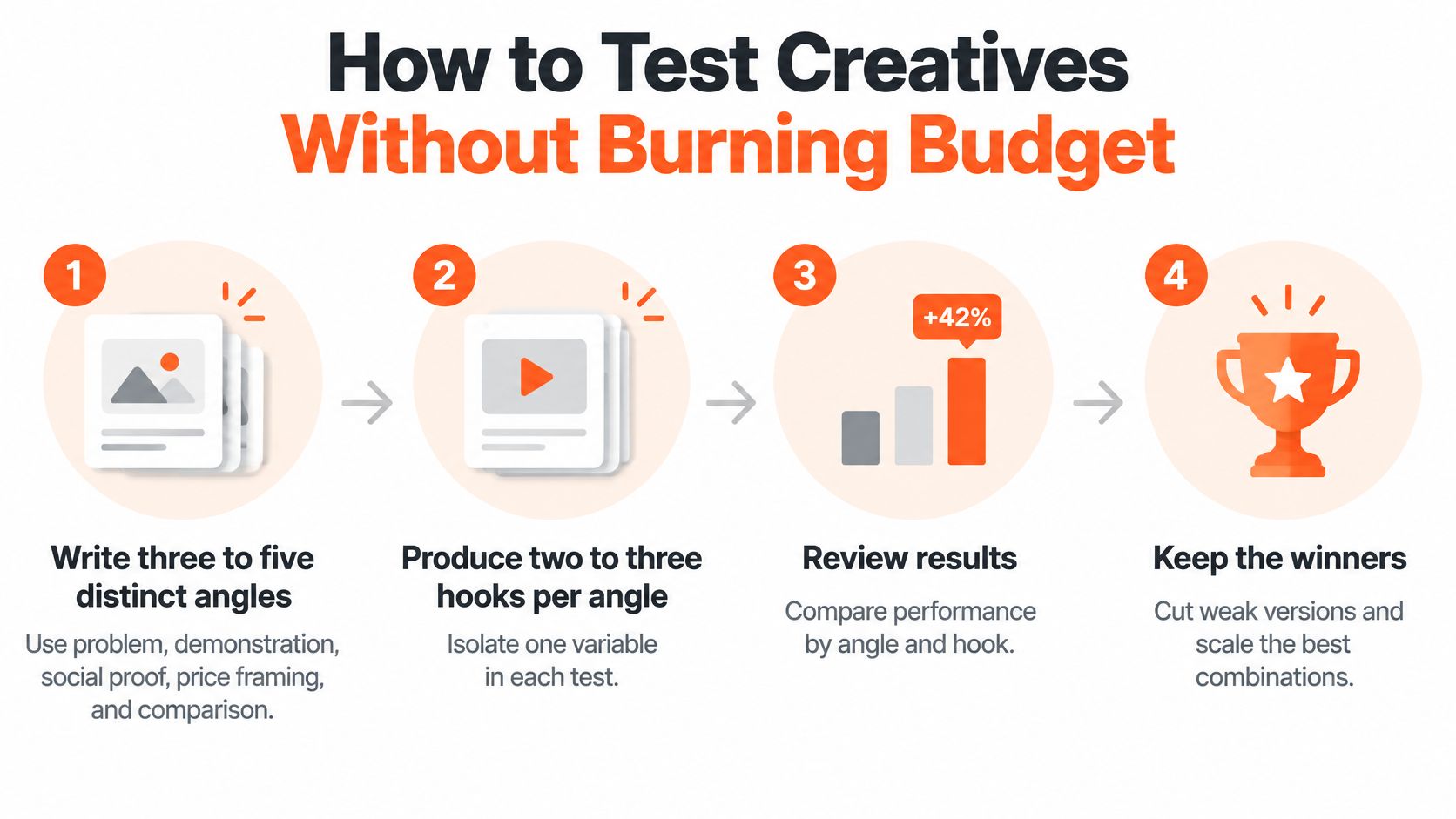
Use this workflow to keep production and evaluation connected.
Build a test you can interpret
- Write distinct angles. Separate the problem, demonstration, genuine social proof, price framing, and comparison ideas. For a pet-hair remover, showing the cleaning process asks a different question from comparing disposable alternatives.
- Change the hook without changing everything else. Create alternative openings while keeping the offer, destination, and main demonstration consistent. Test a manageable batch rather than launching every possible combination.
- Give candidates comparable opportunities. Where the platform supports it, use its experiment tools or separate controlled test groups with equal starting budgets. Keep the audience, optimization event, and attribution settings consistent so delivery differences don't overwhelm the creative comparison.
- Predefine the decision point. Set a desired purchase-evidence level and a hard spend cap derived from your operating acquisition ceiling. Allow normal conversion reporting delays, but don't keep spending indefinitely because a campaign hasn't accumulated its preferred conversion count.
- Pause unaffordable candidates. At the agreed spend cap, stop a creative whose acquisition cost exceeds the ceiling, or that has produced no purchases. Check for checkout or tracking failures before concluding the message itself failed.
- Validate the winner at higher spend. Move the strongest affordable candidate into controlled scaling and maintain a separate challenger test. Keep it only if the acquisition cost remains acceptable after delivery expands.
A spend cap is a risk limit, not a statistical guarantee. If your budget can't support enough purchase evidence, label the result inconclusive, not successful because a video attracted attention.
Diagnose before making another version
Look at the sequence from impression to purchase. Weak engagement may indicate an unclear opening, while product-page visits without checkout activity suggest a mismatch between the advertisement and the offer.
Checkout starts without purchases deserve an operational review. Test the payment methods, shipping charges, mobile buying controls, and discount behavior before commissioning another video.
The distinction between creative concepts and cosmetic variations also matters in Facebook ad testing for SaaS, although ecommerce tests must account for product and fulfillment costs. Changing a caption color doesn't establish whether a different buying argument would work.
Use the accompanying video as a practical supplement while planning your own experiment.
Customer-style footage and straightforward demonstrations are useful candidates, not automatic winners. Obtain permission for content and testimonials, show the actual product, and let purchase economics determine which format survives.
Don't change the landing page halfway through a creative comparison. If you need an urgent page correction, make it, record it, and restart the comparison under consistent conditions.
Trust Signals That Protect Conversion and Accounts
How can your store prove an unfamiliar product is legitimate before you pay to scale it? Start by answering the questions a cautious buyer would ask, rather than adding more badges around the purchase button.
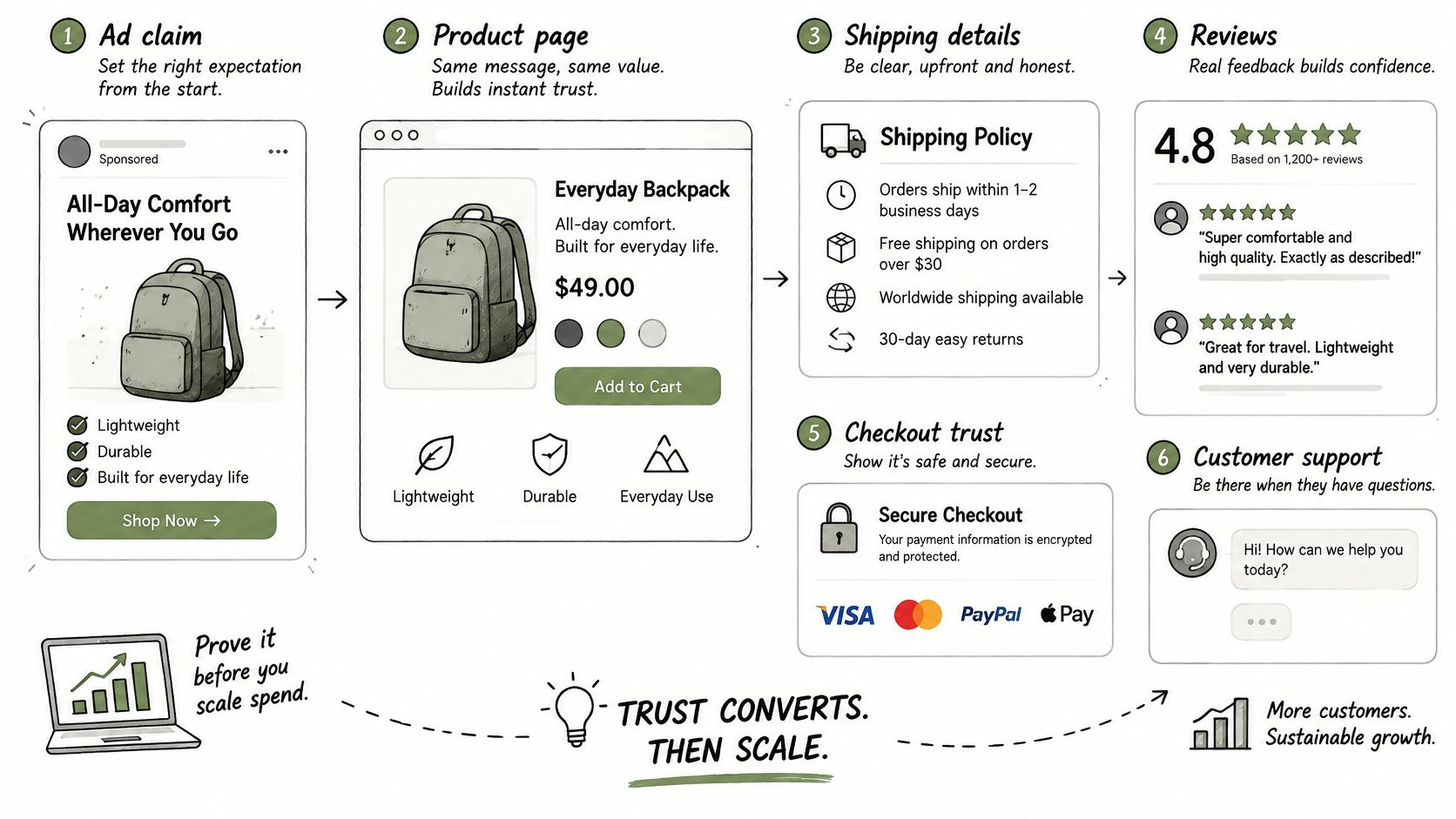
The advertisement, product page, delivery information, and checkout should tell the same story. Meta's advertising standards make the content and claims in advertising central to whether an advertisement is allowed; your own review should also follow those claims through the entire buying experience.
Check the promises buyers depend on
- Identity and fulfillment location. Show who operates the store and describe where orders ship from. Don't imply that you manufacture a supplier's product or hold local inventory when you don't.
- Delivery expectations. State handling and transit windows clearly, separating dispatch from arrival. Base ranges on route-specific shipment records, use the observed median as an internal check, and explain uncertainty where your history is limited.
- Returns and remedies. Explain eligibility, the request process, the return destination, and who pays return shipping. Confirm that your supplier arrangement lets you honor the policy you publish.
- Reachable support. Provide a visible contact channel with response expectations you can meet. Give customers a useful route for late, damaged, or incorrect orders instead of sending them back to the supplier.
Map those checks across the buying journey rather than hiding them on policy pages.
Test transparency without testing deception
Compare a page that emphasizes product benefits with a version that makes delivery, returns, and product evidence more prominent. Both versions must remain truthful; fabricated scarcity isn't an acceptable experimental control.
Keep the traffic source and offer consistent, then evaluate qualified purchases, subsequent refunds, disputes, and support requests. A qualified purchase is one made with an accurate understanding of what the buyer will receive and when.
A click is inexpensive only if the customer it attracts is worth serving.
Don't declare the more persuasive page the winner before its orders have progressed through delivery. An optimistic promise may help close an early sale while creating the complaint that erases its contribution later.
Aggressive countdowns, copied testimonials, and unsupported delivery claims can also jeopardize payment acceptance and advertising continuity. Clear disclosure isn't decoration around the campaign. It's part of the offer you're asking customers to accept.
Reading Competitor Activity Signals Over Time
Activity signals and how to read them
The following are working monitoring categories, not measurements of competitors' financial performance.
| Signal | Definition | What it suggests | Sensible response |
|---|---|---|---|
| Just started | Earliest discoverable ad within the previous fourteen days | A possible new product or market test | Watch for two weeks before adapting the angle |
| Scaling | Ad volume rising sharply in recent weeks | Expanded creative or offer testing | Study the hooks and inspect shipping and returns |
| Struggling | Frequent launches, few ads lasting beyond two weeks | Possible creative or offer difficulty | Look for gaps in the offer, evidence, or landing page |
| Stopped | Active ads drop to zero | A test ended, a budget changed, or an offer was withdrawn | Check whether the store is still trading before outreach |
A single advertisement tells you what a competitor is willing to test. A history of changes gives you better questions to investigate, but still doesn't reveal the answers in its accounts.
Record observations before interpreting them
Check the Meta Ad Library for the earliest discoverable advertisement and current live advertisements. Record the observation date, message, destination, offer, and live-ad count, then return regularly using the same search method.
Keep your own history of advertisements that disappear. Public visibility of inactive commercial advertisements is limited, so a manual search isn't a complete archive of stopped campaigns.
For newly advertising stores, inspect the product and positioning without assuming the store itself is new. An established business can begin advertising a new product, change its page identity, or return after a pause.
Treat each category as a hypothesis
Rising ad volume may indicate expansion, but a brand can also launch many variants without increasing spending. Study what changed between versions: the opening demonstration, customer objection, bundle, or product-page promise.
Frequent replacement can indicate difficulty, but it can also reflect a deliberate testing program. Likewise, an advertisement that remains visible isn't proof of profitable sales; the advertiser may have left it running at a small budget.
A stop deserves especially careful interpretation. Check product availability, seasonality, and whether the brand is active elsewhere before treating the change as failure.
Our monitoring process checks the public Meta Ad Library daily and matches advertisers to their online stores. We flag brands as just started, scaling, struggling, or stopped; records update every day, and most new advertisers appear within a day of their first advertisement.
Use an advertiser database with that distinction in mind: advertising behavior isn't verified revenue, profitability, or financial condition. Our coverage is limited to US brands, so international competitor monitoring requires other sources.
The practical benefit is a better investigation queue. Borrow the customer question a competitor addresses, not its unsupported promise, creative asset, or presumed economics.
Set Your Test Budget and Confirm the Plan
Before launching, write a decision sheet that another person could follow without asking what you meant by a good result. Include the product, audience, acquisition ceiling, creative candidates, spending limit, and review conditions.
Start with free checks. Inspect currently visible competitor advertisements in the public Meta Ad Library, then compare them with your saved observations rather than expecting a complete stopped-ad history.
Complete the launch checklist
- Confirm commercial eligibility. Recheck supplier pricing, shipping charges, and expected order deductions against the acquisition ceiling. Match the channel to the customer's buying behavior, and verify that the product and fulfillment arrangement meet the platform's requirements.
- Fund the experiment, not a feeling. Multiply the candidates you'll launch by each candidate's capped spending allowance, then include any production costs separately. If that total exceeds what you can afford to lose, reduce the batch rather than starving every candidate of useful delivery.
- Inspect the complete purchase. Open the advertisement on a phone, follow its destination, choose a variant, and complete a test checkout. Confirm that the actual price, availability, delivery terms, return conditions, and support route match what you approved.
- Assign the review and decision. Name who will reconcile advertising results with store orders and when they'll do it. Choose among controlled scaling, another focused angle, or pausing to repair the offer, rather than extending spending automatically.
At AdvertiserLeads, our free brand lookup accepts a store domain and shows when the brand started advertising, its live advertisements, and its channels. Our coverage is US-only, so use it within that boundary.
Make the decision explicit
If purchases look affordable but shipment outcomes are still unresolved, keep spending controlled while those orders mature. If results are unaffordable, document the most plausible failure and the change needed before another test.
Don't reset the budget merely because you've made a new video. A new test needs a new hypothesis, not renewed optimism.
Scale only when a fair test shows that customer acquisition stays below your operating ceiling.
Use AdvertiserLeads to investigate US ecommerce brands that have started, expanded, struggled with, or stopped advertising. Enter a competitor's domain in the free brand lookup, review its advertising activity, and use those observations to sharpen your next test without mistaking activity for profit.
Find brands that just started advertising
AdvertiserLeads checks the Meta Ad Library every day and flags ecom brands that just started, scaled or stopped their ads. Create a free account to see the live feed. No card.