Agency Prospecting: How to Find and Qualify Brands
November 16, 2026
A new ecommerce advertiser stays "new" for only 14 days. That window is where agency prospecting gets interesting. Another enormous company directory won't help you here. What helps is identifying US brands whose current ad activity gives you a relevant reason to start a conversation, before the signal goes stale.
The difficult part is deciding what that activity means. A brand launching more ads might need creative support, or it might have everything handled internally. Build your prospect list around testable service hypotheses, then qualify the business before you pitch. Every signal tells you what a brand did. It never tells you why.
Table of Contents
- Signal Types That Make a Brand Worth Calling
- Finding Brands With Saved Searches and Filters
- Verify Each Brand Before You Pitch
- Rank Prospects by Urgency and Fit
- Send a Multi-Touch Sequence After the Signal
- Measure Your First 30-Day Prospecting Test
Signal Types That Make a Brand Worth Calling
Just started, scaling, struggling, and stopped point to different conversations. AdvertiserLeads scans the Meta Ad Library daily and flags ecommerce brands in these categories. Start with the behavior, match it to your service, and check what you still don't know.
Advertising signals and the service each one suggests
| Signal | What It Means | Likely Service Fit | What It Does Not Prove |
|---|---|---|---|
| Just started | First Meta ad found in the last 14 days, with no older listed ads | Onboarding, account structure, first creative | Budget size or sales results |
| Scaling | Sharply increasing ad volume | Creative production, retention, measurement | Profitability |
| Struggling | Frequent launches with few ads lasting beyond two weeks | CRO, landing page and offer diagnostics | Financial distress |
| Stopped | Active ads drop to zero | Diagnosis or reactivation review | Business closure or failure |
For just started, the historical check matters. An established advertiser shouldn't become a new lead because you discovered its latest campaign. Brands with older Meta ads still listed don't count as new advertisers.
For scaling, distinguish ad volume from spending. More creatives or ad variants can suggest production pressure, but they don't establish a larger media budget. For struggling, short-lived launches might reflect disciplined testing rather than poor execution. For stopped, first investigate whether the brand changed channels, finished a promotion, or deliberately paused.
Use the signal to choose the question
Our ads flow monitoring guide provides context for examining launches and stops together. A useful prospecting record preserves the observed pattern rather than reducing the brand to a label.
The commercial context is substantial: U.S. internet advertising revenue reached $294.6 billion in 2025, up 13.9% year over year, according to the IAB/PwC Internet Advertising Revenue Report. That makes advertising changes worth monitoring, but market size doesn't qualify an individual account.
Practical rule: Treat a signal as a reason to investigate, not permission to invent a business problem.
Finding Brands With Saved Searches and Filters
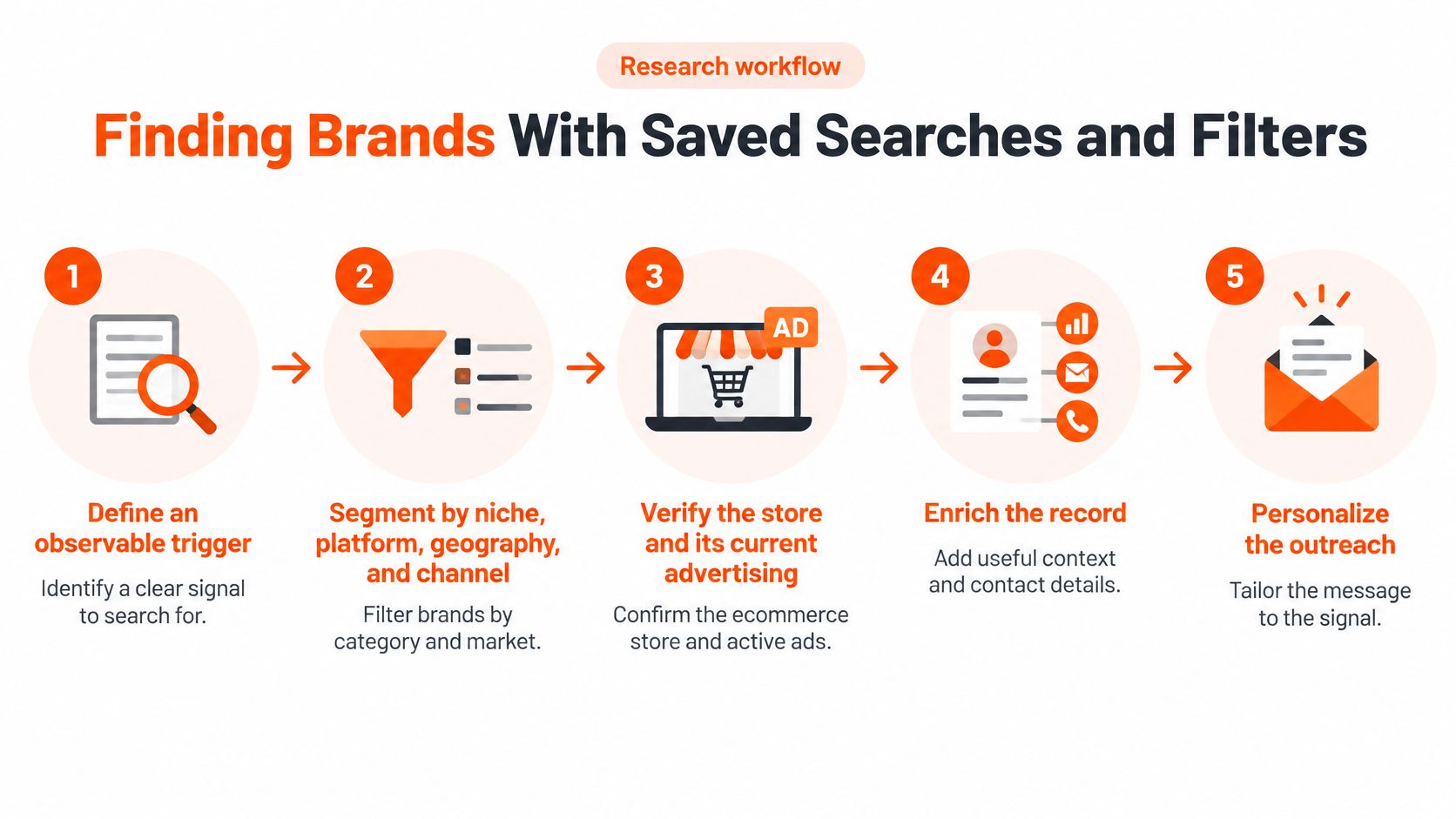
Build a repeatable research workflow: define a trigger, segment the market, verify the store, enrich the record, and personalize outreach. After contact, run the sequence and record outcomes by trigger type. Keeping those stages separate prevents an interesting advertiser from becoming an outreach target before anyone checks its fit.
This workflow keeps research ahead of sending.
Build a search around an offer
Choose a niche you can serve credibly. The free plan allows one searchable niche, so start with a category where your portfolio and delivery process fit. Product familiarity helps you write a useful observation instead of a generic promise to improve growth.
Select the trigger before adding filters. A creative studio might search for scaling brands, while a CRO agency might investigate repeated short-lived launches. Write down the service hypothesis before opening individual profiles so an attractive storefront doesn't distract you from qualification.
Combine relevant filters. Signals can be combined with niche, ad volume, store platform, and advertising channels. For example, search for just-started Shopify brands running Meta ads, then assess geography against your own delivery requirements.
Save the search as an alert. Choose a daily or weekly email digest where your plan supports it. Digests arrive only when new matches appear, so a quiet week isn't evidence that the search is broken.
Check stores you already know. Our free domain-based brand lookup shows when a store started advertising, its live ads, and its channels. Use it to investigate a referral, an existing target account, or a brand you encounter while researching competitors.
Segmentation matters because a UGC studio and a CRO agency shouldn't work from an identical list. The studio needs evidence that a brand could use additional content production. The CRO agency needs a plausible conversion question it can investigate, not just a busy advertiser.
Keep the search narrow enough to review
Use the saved-search and filtering guide to configure the mechanics, then judge the search by reviewability. You should be able to inspect the resulting shortlist in a working session and explain why each account belongs.
If the list is too broad, tighten service fit before increasing ad-volume requirements. A large advertiser outside your specialty can consume more research time without becoming a better opportunity.
A useful saved search returns brands you can qualify, not just brands you can export.
Verify Each Brand Before You Pitch
Qualification deserves as much attention as list building. The State of Agency 2025 report identifies converting prospects into clients as the biggest sales challenge for 33% of agencies, while 25% cite generating quality leads.
Create a compact brand dossier before writing an email. Keep observed facts separate from your interpretation so another team member can challenge the hypothesis.

- Confirm the store. Open the destination domain and verify that it's an ecommerce business. Match the advertiser, landing page, and store identity rather than assuming similar names belong together.
- Inspect current advertising. Check live ads, start dates, and older listed ads that could contradict a just-started classification. Record when you checked, since the account may change before outreach.
- Read the homepage stack. Our checks cover TikTok pixel, Google Ads, Pinterest tag, Snapchat pixel, Reddit pixel, Microsoft Ads, Klaviyo, Attentive, Postscript, Triple Whale, Northbeam, and Elevar.
- Note the channel mix. Distinguish Meta-only activity from Meta plus Google. Cross-channel advertising may justify a different discovery question from a first-channel launch.
- Apply disqualifiers. Remove non-ecommerce stores and brands outside our US coverage. For a net-new agency-acquisition test, exclude brands with a named existing agency and isolated test ads without a meaningful pattern.
Interpret tools without overreaching
Basic pixels with no detected retention tool can justify asking how the brand handles lifecycle marketing. They don't establish that email or SMS is absent, because homepage detection doesn't expose every implementation.
A fuller measurement stack suggests a more advanced opening. Instead of proposing installation, ask how the team reconciles reporting, validates events, or decides which acquisition activity deserves additional investment. Our brand lookup guide helps organize that account-level investigation.
Visible growth isn't the same as a good prospect. The useful question is whether your team can address a verified gap the buyer cares about.
Public ad data can be incomplete. Signals, scores, and brand details may be wrong or out of date, so check important information before relying on it.
Rank Prospects by Urgency and Fit
A rapidly expanding advertiser can look irresistible and still be a poor prospect. The brand might have a capable internal team, be growing profitably, or be increasing acquisition activity to compensate for weak conversion. You can't choose between those explanations from ad volume alone.
Separate visible activity from qualified opportunity before assigning priority.

Look for measurement questions you can resolve
In 2025, 52% of US brand and agency marketers used incrementality testing or experiments, yet 44% questioned result accuracy, according to eMarketer's incrementality analysis. For an agency with measurement expertise, uncertainty can be a more relevant entry point than apparent scale.
A new advertiser might need tracking validation. An expanding advertiser might need blended reporting or a geo-testing plan. A struggling advertiser might need help separating campaign effects from the offer, landing page, and organic demand.
Prospect priority tiers by signal combination
| Tier | Signal Combination | Outreach Window | Confidence |
|---|---|---|---|
| Tier 1 | Just started plus repeated creative launches | Within two weeks of the first ad | Medium: a capability gap is a hypothesis |
| Tier 2 | Scaling across two or more channels | While growth is active | Medium: the brand may have an internal team |
| Tier 3 | Struggling with frequent short-lived launches | Over the next two to four weeks | Lower until a diagnostic confirms the cause |
| Tier 4 | Stopped after sustained activity | Monthly review | Low: a pause may be seasonal or planned |
These are recommended operating windows, not measured buying-intent benchmarks. Use them to maintain a review cadence, not to claim that a prospect is ready to hire.
Score fit after checking exclusions
Use a simple internal rubric: assess signal strength, service fit, measurement ambiguity, verification status, and disqualifiers. Treat disqualifiers as a gate rather than an additive score, because a strong signal shouldn't cancel a fundamental mismatch.
For the remaining criteria, assign zero for absent evidence, one for a plausible but incomplete case, and two for clear support. Work the highest totals first within their outreach windows; a total below five out of eight returns to monitoring. This is a prioritization convention, not a validated prediction model.
Use this video alongside the rubric when reviewing your prospecting approach.
Open attribution conversations neutrally. Ask how the team reconciles platform conversions with business outcomes, then propose a narrowly scoped validation plan rather than accusing its current team of getting measurement wrong.
Send a Multi-Touch Sequence After the Signal
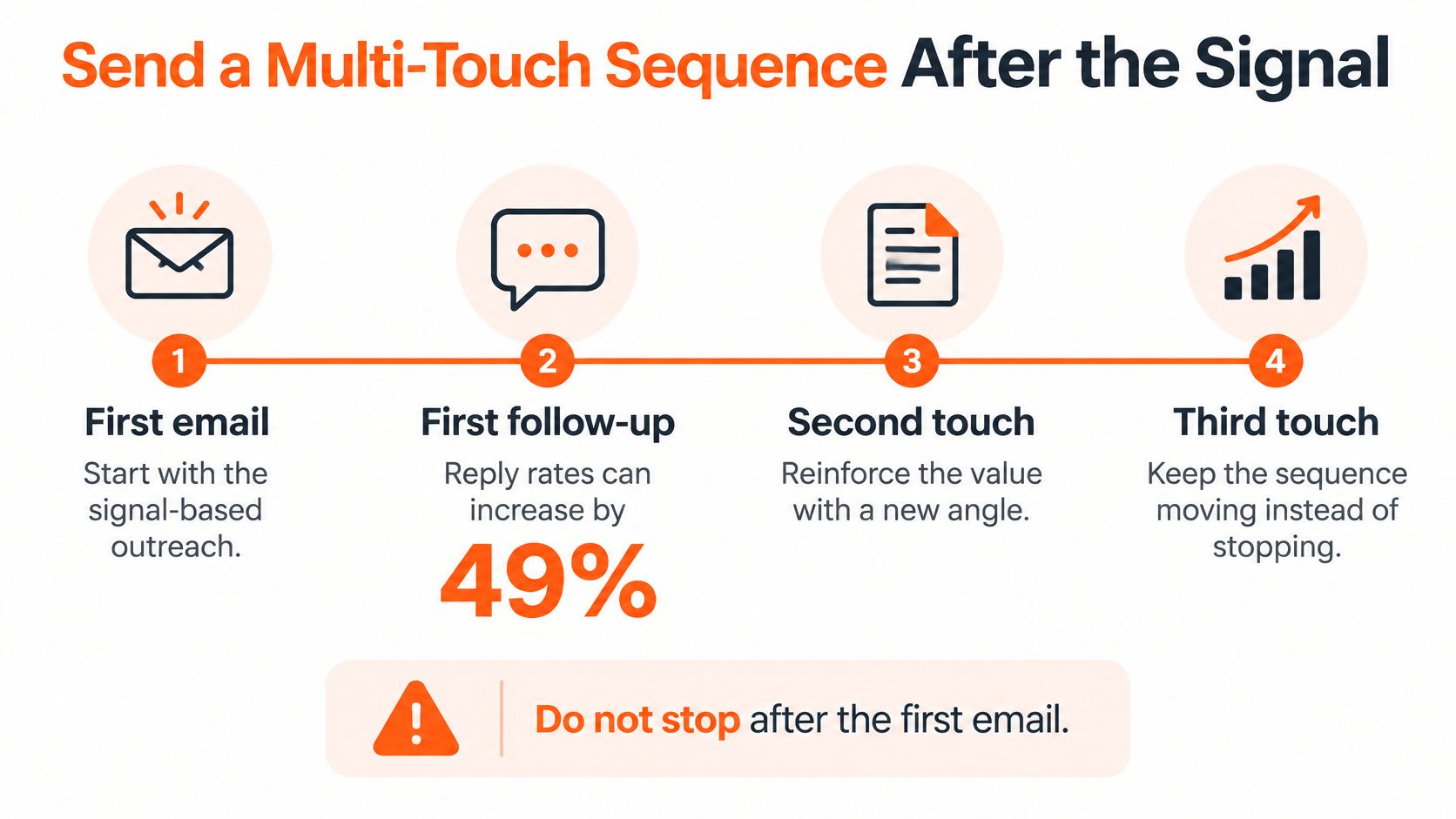
Stopping after the first email wastes the research you've already done. HubSpot's sales statistics summary reports that the first follow-up can increase reply rates by 49%. That supports following up, not repeating the same pitch until someone answers.
Use a short sequence in which every message adds information.
Four-touch outreach sequence after a signal
| Touch | Timing | What It Adds |
|---|---|---|
| Touch 1 | Day 0 | Trigger observation plus one relevant outcome |
| Touch 2 | Day 3 | A concrete diagnostic or short audit |
| Touch 3 | Day 7 | A specific hypothesis about the likely bottleneck |
| Touch 4 | After Day 7 | A low-pressure closing message |
Treat this schedule as a starting playbook. Stop scheduled messages when someone replies, opts out, or proves to be the wrong contact.
Write the observation before the offer
Describe the event you can substantiate. Recent creative expansion can justify a conversation about testing capacity; it doesn't justify declaring that campaigns are failing.
Match the offer to the account's situation. Propose onboarding support to a new advertiser, creative production or retention support to an expanding brand, and a bounded CRO or campaign diagnostic where the cause needs investigation. The first ask should make the next step clear, such as permission to send a short testing outline.
Gong's prospecting email benchmarks show a 1.8% median reply rate, 3.9% for top-performing representatives, and median rates of 2.1% for manual emails versus 1.1% for automated emails. These aren't agency-specific guarantees, but they support using automation for discovery and routing while a person writes the account-specific argument.
Enrich only the qualified records
AdvertiserLeads doesn't include contact details. Export brands to CSV and use separate tools such as Clay or Apollo to identify the appropriate decision-maker; customers may use the data to research and contact brands for their own business.
Verify the person's role before enrollment and suppress bounced or opted-out contacts. Track reply rate, positive-reply rate, meetings per hundred prospects, and conversion by signal category, rather than opens alone, which privacy and security systems can distort.
Measure Your First 30-Day Prospecting Test
Start this week with a small verified batch from a single saved search. For example, review ten brands, write a service hypothesis for each, and enroll only those that pass your qualification checks. This is a workflow test before it's a reliable estimate of long-term response performance.
Keep the test interpretable
- Run the complete sequence. Send the initial observation, add the diagnostic and bottleneck hypothesis, then close the loop. Record exceptions so missed follow-ups don't masquerade as poor targeting.
- Maintain an account-level log. Store the trigger, verification date, offer, contact role, replies, positive replies, and meetings. Keep trigger categories separate so a promising segment doesn't hide an irrelevant one.
- Diagnose before expanding. Compare results with the prospecting benchmark, but don't treat a small batch as conclusive. Audit deliverability, targeting, message relevance, and offer positioning before adding more accounts.
Test discipline: Keep the audience and offer stable when comparing message variants. Otherwise, you won't know what caused the difference.
Match capacity to the plan
The free plan includes one searchable niche, ten monthly brand reveals, a weekly alert, and five daily brand lookups. Starter unmasks every brand in one niche and adds one saved search with daily alerts plus CSV export up to 500 rows monthly.
Pro includes every brand with full ad history across three niches, up to five saved searches with daily email, Slack, or webhook alerts, and 2,500 monthly CSV rows. Agency costs $249 per month, extends Pro to all niches, and includes unlimited saved searches, all exports plus API up to 10,000 rows monthly, and three seats. Choose capacity around the records your team can qualify and follow through, not the largest list it can download.
AdvertiserLeads turns changes in ecommerce advertising activity into searchable signals, brand profiles, and saved alerts. Visit AdvertiserLeads to build a focused search, verify the matching stores, and start prospecting with a specific service hypothesis instead of a generic pitch.
Find brands that just started advertising
AdvertiserLeads checks the Meta Ad Library every day and flags ecom brands that just started, scaled or stopped their ads. Create a free account to see the live feed. No card.