Ads Flow Monitoring for Smarter Prospecting
November 12, 2026
The Association of National Advertisers estimated that $26.8 billion in global media value was lost annually to programmatic inefficiencies in its Q2 2025 transparency benchmark. That's a useful warning for prospecting: visible advertising activity and efficient advertising aren't the same thing. Ads flow monitoring helps you spot changes worth investigating, not identify profitable businesses from an ad count.
Table of Contents
- Why Ad Flow Changes Beat a Static Store List
- Four Ad Flow Signals and How to Use Each
- How Public Ad Archives Record the Flow
- When a Missing Ad Is Not a Real Stop
- What an Ad Flow Signal Cannot Prove
- How to Run Ads Flow Monitoring Each Morning
- Match the Signal to the Offer Then Verify
Why Ad Flow Changes Beat a Static Store List
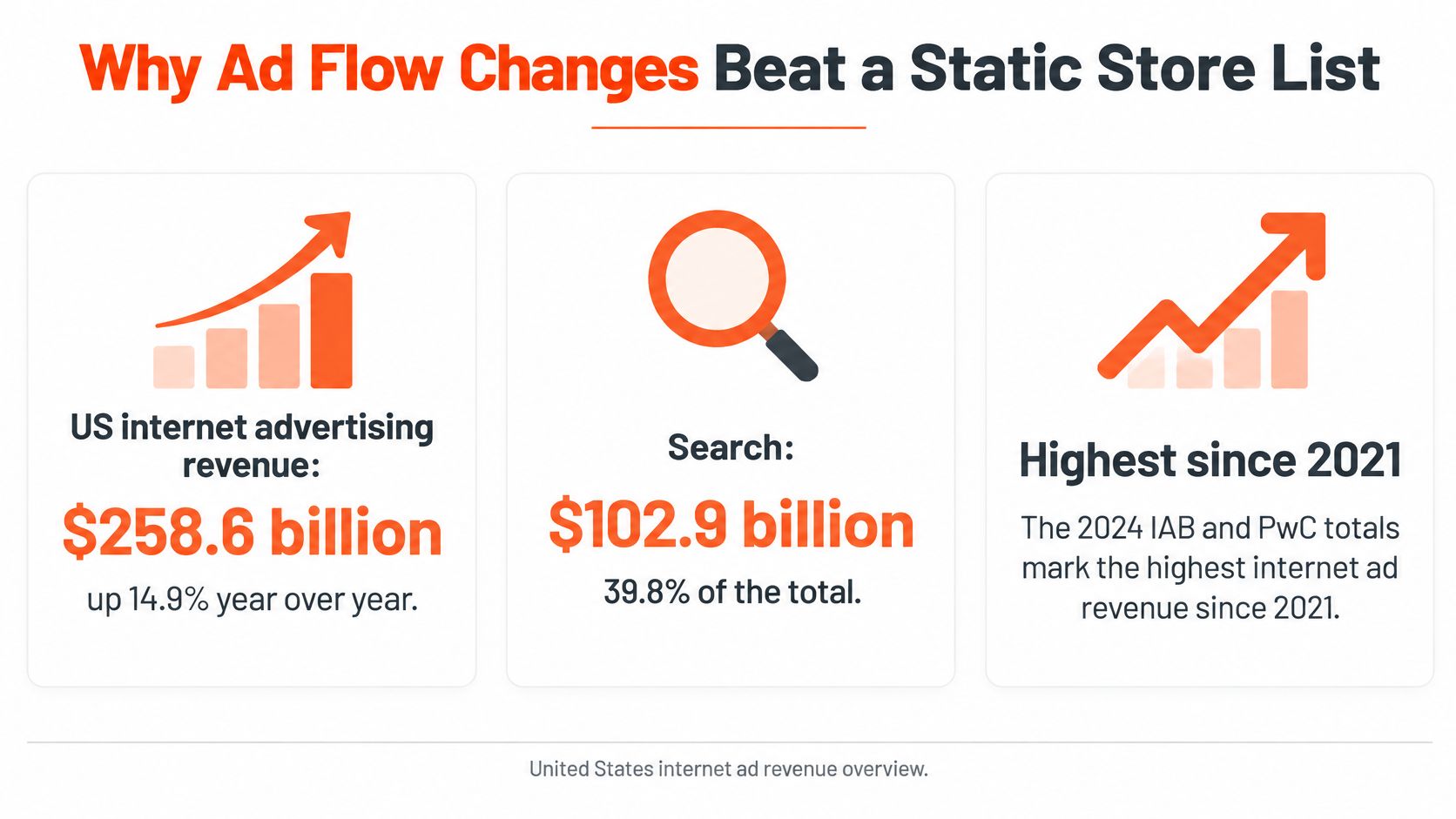
U.S. internet advertising revenue reached $258.6 billion in 2024, up 14.9% year over year, according to IAB and PwC. Search remained the largest category at $102.9 billion, representing 39.8% of total digital advertising revenue. Those totals explain why current advertiser behavior deserves attention alongside store platform, niche, and product category.
Say you're researching skincare stores. A spreadsheet tells you which brands use Shopify, but it doesn't tell you which recently began advertising, which keep introducing creative, or which no longer have ads listed on a watched channel. You could send everyone the same pitch, but you'd have no behavioral reason to prioritize one store over another.
Ads flow monitoring means repeatedly checking public ad archives and recording changes in advertiser presence, live-ad counts, creative launches, and observed inactivity. The useful unit isn't an individual ad. It's a dated change associated with an identifiable advertiser and store.
Replace the snapshot with an observation log
Think of a store list as a photograph of a shop window. Repeated observations are closer to a shopfront log: you record when the display first appeared, when it expanded, how often it changed, and when it went dark. You still haven't seen the till receipts.
That distinction makes ecommerce lead generation more specific. Instead of approaching a skincare store merely because it exists, a researcher can investigate whether a recent change creates a relevant opening for creative production, media buying, or conversion work.
- Identity: Which advertiser and storefront did you match?
- Timing: When did you observe the change?
- Scope: Which archive, channel, and market did you check?
- Action: What should someone verify before outreach?
Working labels such as just started, scaling, struggling, and stopped organize that log. They aren't diagnoses. The revenue figures describe the advertising market, not any individual brand's profit, and the practical deliverable is a signal table with enough context for another researcher to check your conclusion.
Four Ad Flow Signals and How to Use Each
Ad flow signals for prospecting
| Signal | What you observe | Outreach it supports | What else it might be | Check first |
|---|---|---|---|---|
| Just started | Earliest discoverable ad within 14 days, after older library ads are ruled out | Media buying, onboarding, or initial creative support | New ad account, rebrand, or earlier ads under another name | Confirm the store is live and no older ads remain listed |
| Scaling | Live ad volume up sharply in recent weeks | Creative supply, retention, or analytics around expanded activity | Duplicated creatives, a restructure, or heavy testing without better economics | See whether ads survive and whether the offer and page stay stable |
| Struggling | Many new launches and few ads lasting past two weeks | Conversion rate, landing-page, offer, or store fixes | Seasonal tests, a creative refresh, or learning-phase resets | Review the page and offer, and check another channel for surviving ads |
| Stopped | Transition from active ads to zero on the watched channel | Win-back, a channel switch, or investigation of a pause | Seasonality, inventory, a tracking change, or a one-platform pause | Check another channel and a longer window before calling it distress |
These are behavioral classification rules, not industry performance benchmarks. The time windows define the publisher's signal labels; they don't establish how long an effective campaign should run.
Use the label to choose a question
For just started, the valuable distinction is between newly observed and new within the available archive history. An established brand can appear under a fresh advertiser identity. Check older listed ads before writing an introductory pitch that assumes the team has never bought media.
A sensible opening offers help with campaign setup or creative testing. It doesn't congratulate the business on its first-ever campaign unless the business has confirmed that history.
For scaling, compare the advertiser against its own recent baseline. A jump in listed ads may create a reason to investigate creative production capacity, but it doesn't prove that spend increased. Ask whether the team needs a repeatable way to produce new concepts rather than asserting that its acquisition program is growing profitably.
Prospecting rule: Choose the offer from the observed change, then write the message around a question you can defend.
Handle the sensitive labels carefully
Struggling is useful as an internal sorting label and risky as customer-facing language. Say a skincare brand keeps replacing ads while sending visitors to a confusing bundle page. That combination gives a CRO researcher something concrete to inspect, but the short creative lifetimes alone don't establish a landing-page problem.
Review the destination before pitching. Look for mismatched claims, an unclear bundle, unavailable variants, or a mobile purchase path that requires unnecessary work. If you can't identify a specific issue, don't invent one to fit the signal.
Stopped needs an equally restrained approach. The researcher should establish that the watched channel previously had active ads and now lists none, rather than finding an empty search result. A useful message asks about future acquisition plans or offers help with a restart; it doesn't imply that the business failed.
Keep the rival explanation beside the outreach idea in your working sheet. That small discipline helps prevent a sales team from turning observable advertising behavior into an unsupported claim about sales or financial condition.
How Public Ad Archives Record the Flow
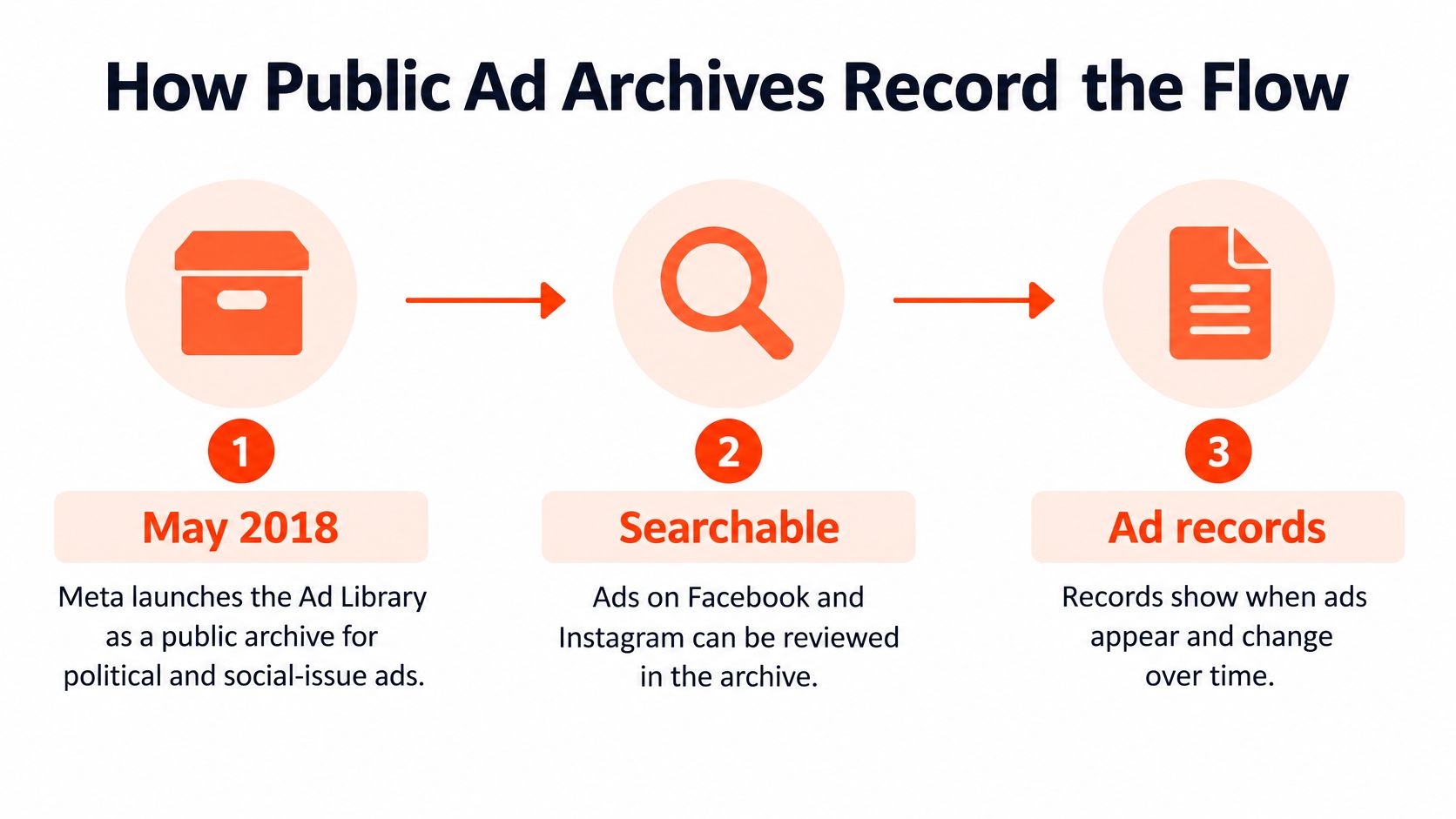
Meta first launched its Ad Library in May 2018 as a public archive for political and social-issue advertising, according to Meta's account of its political-ad transparency work. For that political and issue material, the archive can provide advertiser identity, spending ranges, impressions, demographic reach, and status, with storage for up to seven years.
That history matters because it established public access to records that could be reviewed beyond a single encounter with an ad. Don't assume, however, that the detailed fields available for political advertising also exist for ordinary ecommerce campaigns.
Google's Ads Transparency Center announcement describes a searchable repository spanning Search, Display, Gmail, and YouTube, with information such as region, format, and when an ad last ran. Google also describes API access for ads served in the European Economic Area, with different access arrangements outside that area for regulators and self-regulatory organizations. Automation therefore needs a coverage check, not just a working connector.
Store observations you can compare
A daily monitor needs a stable record structure. Otherwise, a renamed advertiser or slightly altered creative can look like a completely new prospect.
- Advertiser identity: Preserve the displayed name and any identifier the archive supplies.
- Creative fingerprint: Save an available ad identifier or a reproducible fingerprint using creative and destination details.
- Observation dates: Separate when you first saw the record from any start or last-run date supplied by the archive.
- Region and format: Keep these attached to the observation rather than discarding them during aggregation.
- Source coverage: Record the archive, search scope, retrieval time, and whether the check completed successfully.
A Facebook ad-checking workflow is more useful when someone can retrace the search and inspect the underlying advertiser. A bare total is difficult to audit.
Distinguish an event from your discovery of it
First seen means your monitoring process discovered an ad on that date. It doesn't necessarily mean the advertiser launched it then. Likewise, your last successful observation isn't automatically the campaign's end date.
Keep archive-supplied dates and researcher-observed dates in separate fields. That preserves the difference between what the platform reports and what your process detected.
The result is an observation history, not a spend ledger or sales record. Depending on the archive and its retention rules, the same brand can appear newly discovered, continuously present, or absent without its overall advertising strategy having changed.
When a Missing Ad Is Not a Real Stop
A missing observation should begin as unknown, not stopped. Before assigning a commercial meaning to a gap, establish whether the search succeeded, whether the advertiser matched correctly, and whether the archive should still contain the relevant material.
A comparative study of advertising repositories describes Meta's general ads as primarily indexed while active, whereas Google retains nonpolitical ads for up to 365 days and covers verified advertisers. It also identifies Google's advertiser-or-website search constraints and limitations in filtering and systematic matching.
Meta and Google coverage for flow checks
| Archive | What stays visible | How you search | What a gap can mean |
|---|---|---|---|
| Meta Ad Library | General ads mainly while active; political and issue material has separate long-term retention | Searchable public archive of Facebook and Instagram ads | Ad ended, or the general-ad index no longer lists it |
| Google Ads Transparency Center | Retained nonpolitical ads from verified advertisers, with region, format, and last-shown information | Advertiser or website name; no broad copy search | Different name or domain, advertiser not covered, an unobserved format, or a true pause |
Check the identity before the activity
Say a homeware store trades under a consumer-facing brand, but its advertiser appears under a parent company. Searching only the storefront name can return nothing. The right response is to inspect the destination domain and advertiser identity, not mark the store inactive.
Similar mismatches arise when a brand uses another domain, an agency-managed account, or a channel outside your monitoring scope. These are false-negative risks: your process misses advertising that may exist.
Absence from an archive is evidence about your search result, not proof that the brand bought no advertising.
Keep retrieval status separate from ad status. A failed request, an unmatched advertiser, and a successful search with no current ads are different events and should occupy different fields.
Avoid a misleading cross-platform score
A historical Google record and a currently active Meta listing aren't interchangeable units. Adding both into a single activity score without explaining retention and status can make one brand look more active because its records remain searchable longer.
For global prospecting, preserve market and source coverage alongside each classification. Use channel-scoped labels such as no current Meta ads observed, rather than company-wide conclusions such as advertising stopped.
When uncertainty remains, extend the observation window and recheck the match. Don't convert missing days into ended campaigns just to make a dashboard look complete.
What an Ad Flow Signal Cannot Prove
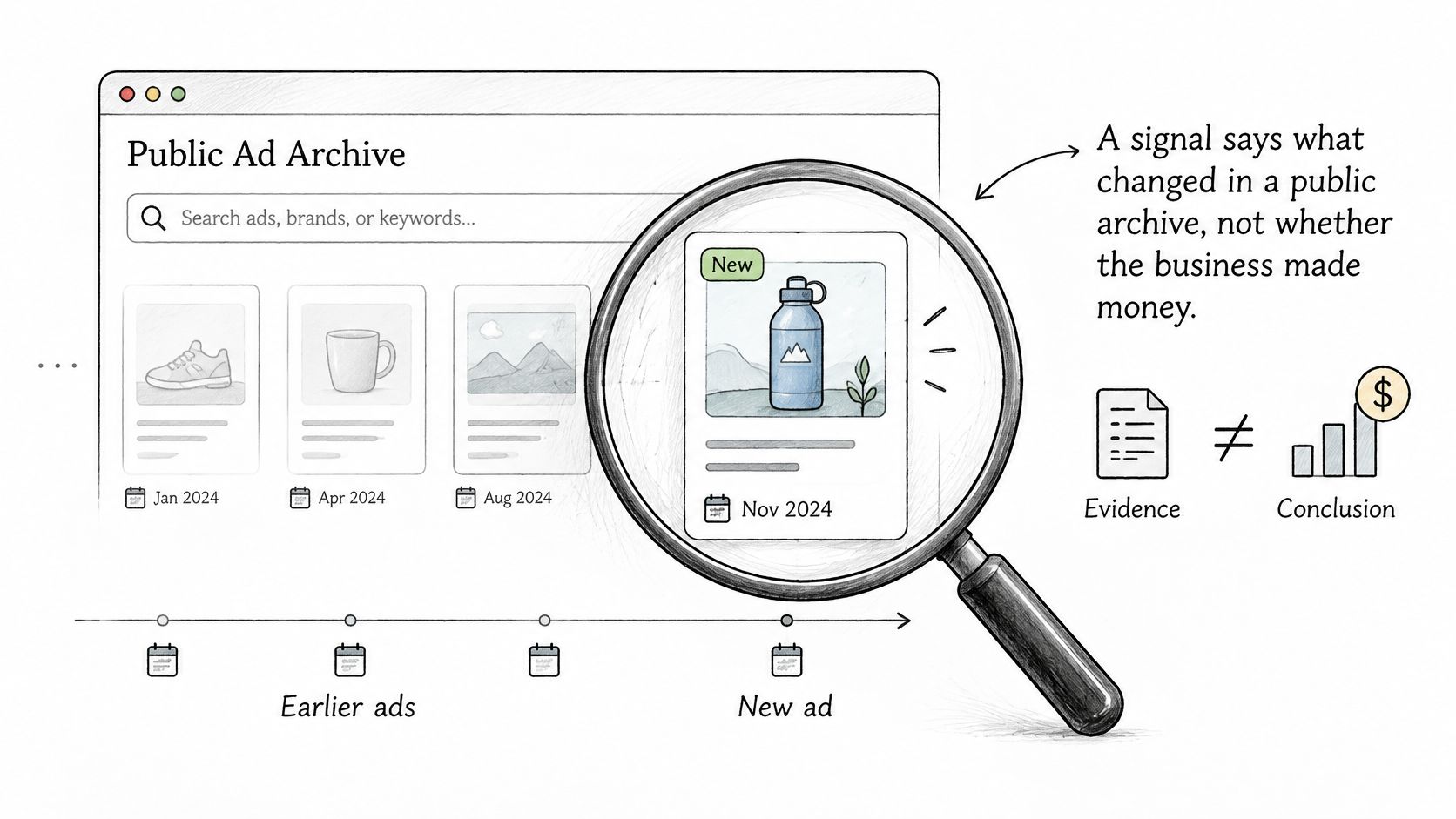
A signal says what changed in a public archive, not whether the business made money.
A defensible statement describes an observation: creative count increased, launches repeated, or no current ads were listed in a completed channel check. Revenue, profit, return on ad spend, and financial distress require different evidence.
The Journal of Advertising analysis of public ad repositories identifies limited or missing targeting, spend, reach, clicks, conversions, and revenue information in Meta's general library, alongside gaps in reliable nonpolitical spend, targeting, and impression information in Google's repository. Those omissions prevent a public archive from functioning as a performance report.
More creative doesn't establish better economics
Suppose a brand adds many variations of the same product demonstration. That could reflect a productive testing program, but it could also reflect duplication or difficulty finding a workable message. A creative studio may have a relevant service in either situation, though the appropriate conversation differs.
The mistake is ranking the brand as a stronger prospect solely because the count is larger. A smaller advertiser with a clear need and an accessible decision-maker may be more suitable than a highly active brand whose production process is already well served.
Advertising attribution requires connecting exposure or engagement to later outcomes. Academic work on online advertising attribution treats effectiveness estimation as a causal problem and warns against misinterpreting observational methods when causal assumptions fail. Archive metadata doesn't supply that missing outcome connection.
Give confidence to the observation, not the diagnosis
A researcher can be highly confident that a completed search returned no current ads and remain uncertain about why. Keep those judgments separate.
- Observation confidence: Was the advertiser match clear, and did the archive check complete?
- Alternative explanation: What plausible non-performance reason could produce this pattern?
- Independent verification: Does the store load, is the advertised offer available, and does another channel show activity?
- Performance evidence: Has the business shared permissioned first-party results that support an economic claim?
Store-platform markers and estimated traffic can add context, but neither verifies profitability. Even first-party reporting needs appropriate definitions and a sound measurement method before you make causal claims.
For outreach, this restraint improves specificity. You can offer to investigate an acquisition or conversion question without pretending you've already diagnosed the answer.
How to Run Ads Flow Monitoring Each Morning
Treat the morning run as a repeatable research operation. Keep the collection method consistent, record exceptions, and send only checked observations into the outreach queue.
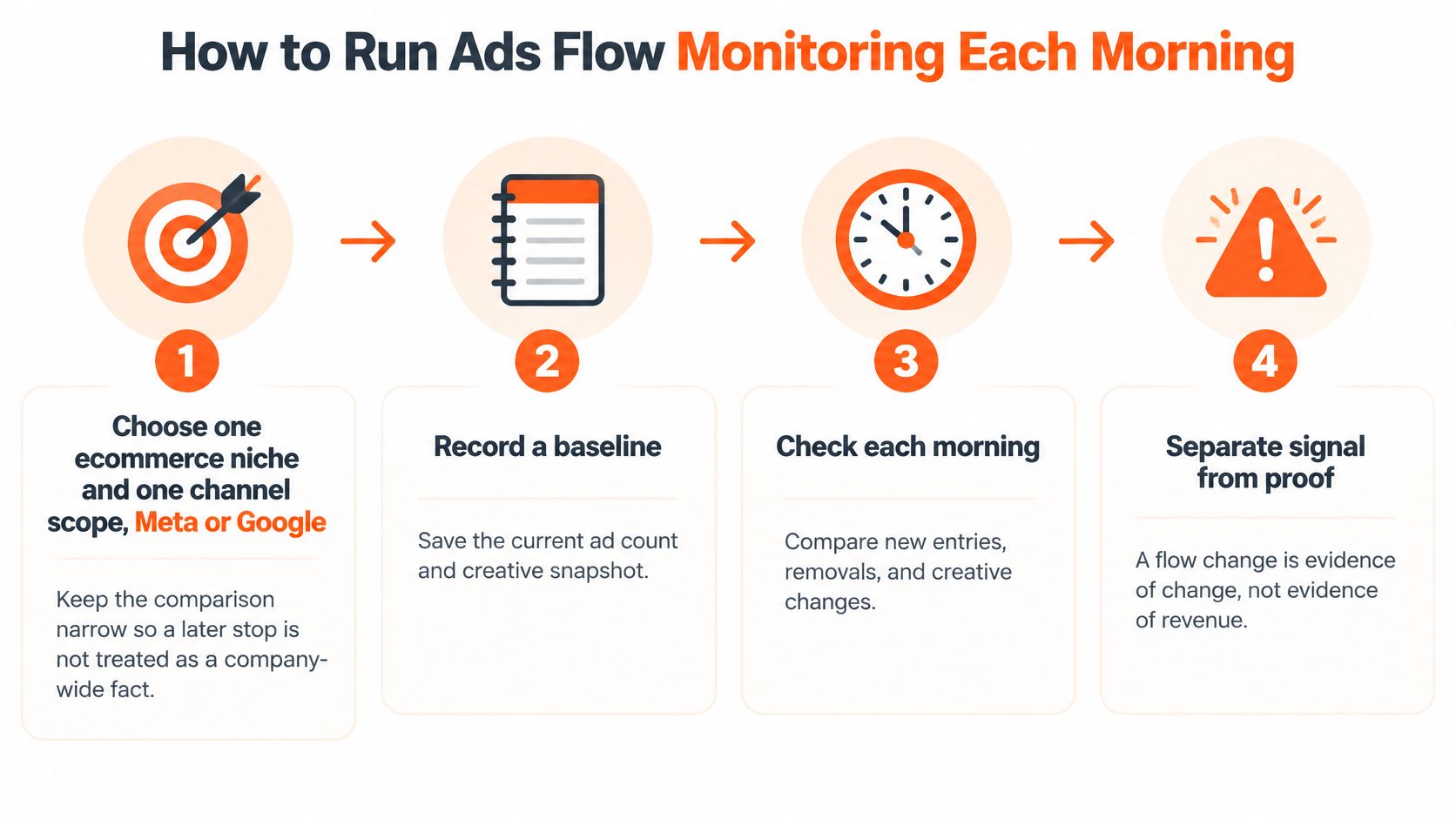
Choose a narrow scope. Select an ecommerce niche and define whether you're monitoring Meta, Google, or separately labeled views of both. Include the market so that a regional search doesn't become a worldwide claim.
Record the baseline. Save advertiser identity, destination domain, current ad count, creative fingerprints, observation dates, region, format, and retrieval status. Keep a snapshot you can inspect rather than overwriting yesterday's total.
Recheck on a daily cycle. Compare newly observed records, continuing records, and records no longer returned. Our data is updated every day, and most new advertisers appear within a day of their first ad, but discovery timing isn't a guarantee that every launch will be immediately visible.
Rule out older listed ads. Our brand checks run each morning, and new advertisers are flagged in the afternoon, UTC, after checking that Meta doesn't still list older ads. This prevents a recent creative refresh from being mistaken for a new advertiser.
Turn collected records into a checked queue
Match the destination to a real store. We check landing domains using Shopify's
/products.jsonendpoint and response headers, followed by homepage markers. The purpose is identity verification: an advertiser name alone isn't enough to establish which store you should approach.Classify the change only. Apply the behavioral rule and preserve the evidence behind it. We scan the Meta Ad Library daily for ecommerce brands whose activity fits the just-started, scaling, struggling, or stopped patterns.
Save the working filter. A useful advertiser database workflow keeps niche, scope, signal, and review status consistent. Use a digest of newly matching records where available, rather than repeatedly reviewing an unchanged list.
Verify before handoff. Open the landing page, inspect the offer, and check another channel where practical. Mark unresolved matches and missing observations as unknown, and attach a concrete reason for the proposed outreach.
The morning list should tell a researcher what to investigate next. Public records can be incomplete or late, so it isn't a finished statement about the business, and the sales message shouldn't treat it as one.
Match the Signal to the Offer Then Verify
Choose prospects by service fit, not by the most dramatic label. An observation becomes useful when you can connect it to work your team is equipped to do.
For paid social and PPC agencies, newly observed advertisers can justify a campaign-setup conversation, while repeated short-lived tests can justify an acquisition review. Freelance media buyers can use the same timing to ask an informed question about the current campaign rather than lead with a generic capability list.
Choose the problem you can actually inspect
- UGC creators and creative studios: Favor sustained launch activity when you can propose a specific production process or missing creative concept.
- Email, SMS, and retention agencies: Investigate brands expanding visible activity, then review their signup and lifecycle experience before pitching.
- CRO and Shopify teams: Use unstable testing patterns to prioritize page reviews, not to declare that the store has a conversion problem.
- Ecommerce software teams: Combine platform compatibility with current advertising activity so the product is relevant to both the store and its workflow.
- Influencer and affiliate platforms: Approach new or expanding advertisers with a complementary acquisition proposal, without assuming they want to replace existing channels.
Make a small, verifiable next move
Our domain lookup lets you inspect a store's advertising start date, live ads, and channels. Searches can combine signals with niche, ad volume, store platform, and channels, and any search can be saved as an alert. The Free plan costs $0 and includes a masked live feed for one niche, 10 reveals a month, one weekly alert, five brand lookups a day, and no export.
Contact details aren't included, so identifying individual contacts requires separate enrichment. Public ad data can also be wrong or out of date: confirm the store and current ads before sending, and describe only the change you've checked.
Use AdvertiserLeads to look up a store domain or save a niche-and-signal search for newly matching ecommerce brands. Start with an offer you can support, review the underlying activity, and verify the store before turning an ads flow signal into outreach.
Find brands that just started advertising
AdvertiserLeads checks the Meta Ad Library every day and flags ecom brands that just started, scaled or stopped their ads. Create a free account to see the live feed. No card.