Ecommerce Lead Generation: Strategies and Timely Signals
November 2, 2026
Businesses in 46 economies generated nearly $28 trillion in ecommerce sales in the update reported by the UNCTAD Digital Economy Report 2024 overview, and those economies accounted for roughly three-quarters of global GDP. That figure reframes ecommerce lead generation for an agency owner. You're not hunting through a small pool of online shops. You're choosing, from a huge and constantly changing market, which brands have just given you a reason to contact them now.
That choice is where most prospecting goes wrong. A long list of stores feels productive, but it doesn't tell you who started advertising this week, who's spending aggressively, or whose ads keep dying after a few days. Think of an active ad as a timing event rather than proof that a brand wants to buy your service. It shows something happened on a date you can check. It doesn't show budget, profitability, satisfaction with a current agency, or readiness to switch.
The approach below is deliberately step by step. You'll compare the main ways to find ecommerce prospects, learn how to read four advertising signals, qualify brands beyond those signals, and then apply the method to two hypothetical brands. The aim isn't a bigger spreadsheet. It's a shorter list where every name comes with a plausible problem, a timely reason to write, and an honest note about what you still don't know.
Table of Contents
- Ecommerce Lead Generation Strategies at a Glance
- Why Timing Beats Static Store Lists
- Decoding Timely Advertising Signals
- Qualifying Prospects Beyond the Ad Signal
- A Worked Example of Pitching a Scaling Brand
- Misconceptions That Waste Outreach Time
- Build Your First Prospect List This Week
Ecommerce Lead Generation Strategies at a Glance
Start by separating where prospects come from from why you'd contact them today. Those aren't the same question. A strategy can produce accurate company records and still leave you guessing about timing, while another produces fewer names but gives each one a dated trigger for outreach.
Ecommerce Lead Generation Strategies by Fit and Timing
| Strategy | Finds prospects by | Best-fit provider | Timing strength |
|---|---|---|---|
| Ad-activity monitoring | Brands that start, scale, struggle or stop Meta or Google ads | Paid social and PPC agencies, media buyers | High, dated events |
| Store platform lists | Stores running a given platform, app or tracking pixel | Ecommerce SaaS and Shopify app teams | Low, static records |
| Gated content | Visitors who download a checklist or benchmark report | Agencies with an existing audience | Medium, tied to the offer's urgency |
| Referral and partner networks | Warm introductions from apps, 3PLs and lenders | Any provider with partner relationships | Medium to high, set by partner knowledge |
| Search ads on agency keywords | Searchers already looking for help | Agencies with a conversion-focused landing page | Medium, shows intent but not timing |
| Cold outbound email | Named contacts found with enrichment tools | Creative studios, CRO and retention agencies | Low to medium, set by the trigger used |
| Community participation | Operators asking questions in forums and groups | Freelance media buyers and consultants | Medium, shows problems as they happen |
Read the timing column first if your service solves a problem that appears at a specific moment. A creative studio, for example, benefits most when a brand is launching ads quickly and needs fresh concepts to test. A Shopify app team may care more about platform fit than this week's ad activity, so a store list can be enough to build a territory.
The other columns prevent you from copying a strategy that doesn't fit your offer. Gated content works only if ecommerce operators already visit your site or follow your content. Partner introductions can be excellent, but they're limited by how many relevant partners you know and how often those partners see a brand in trouble. Search ads capture stated intent, though a searcher may be comparing prices months before they're ready to hire anyone. Community participation reveals problems in the operator's own words, but it requires consistent time and doesn't scale neatly.
Cold outbound sits across the middle because email itself isn't a signal. It's a delivery method. An email sent to every store on a platform list has weak timing. The same email sent after a brand's ads stopped, with a specific re-entry suggestion, has a much clearer reason to exist.
Choice rule: Shortlist two strategies that match your service and the timing you can act on, and ignore the rest until those two are working.
That discipline matters because your potential market spans manufacturers, wholesalers, retailers, direct-to-consumer brands, and cross-border sellers. Narrowing by provider fit and timing strength is what turns that broad market into a prospect list you can realistically work each week.
Why Timing Beats Static Store Lists
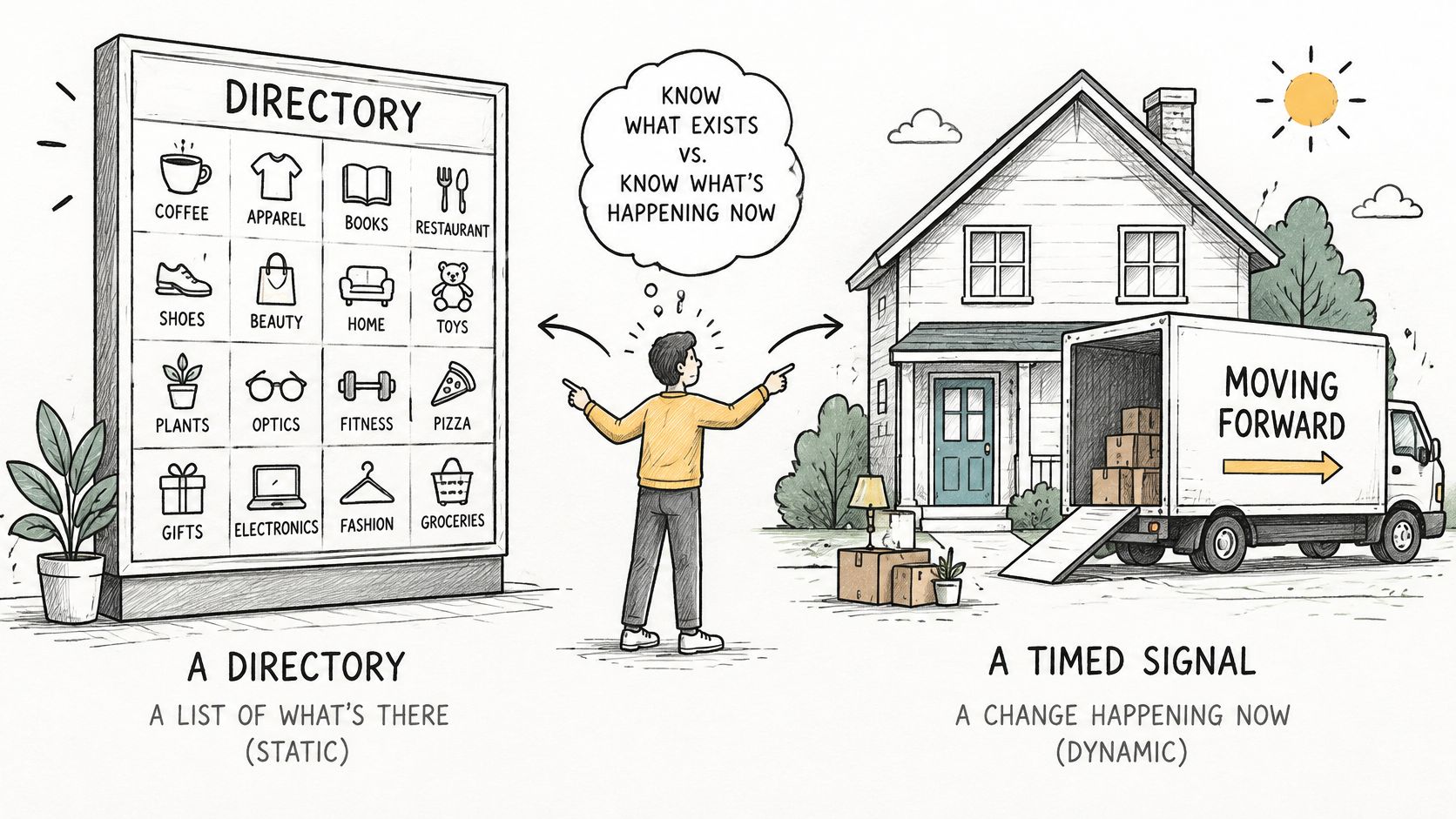
A store list is like a phone directory. It tells you who exists, where they are, and sometimes what technology they use. A timed advertising signal is more like a moving van outside a house. It doesn't tell you everything about the people inside, but it tells you something has just changed, and that change gives you a reason to pay attention now rather than next quarter.
That analogy leads to a practical definition you can use every day. A usable lead isn't just a company name. It's a company plus a reason to contact it now.
There's a solid methodological reason to think this way. The distinction matters in UNCTAD's ecommerce measurement update, which separates business ecommerce sales from general internet adoption and uses transaction values reported by national statistical offices, Eurostat, OECD-related datasets, and other competent agencies. In plain language, having a website is not the same as currently generating demand.
Apply that same distinction to prospecting. A store can be live, well designed, and built on the right platform while its owner has no current growth push, no advertising budget in use, and no problem they're trying to solve this month. A static record can't distinguish that store from one whose owner launched ads four days ago. Both rows look identical in a spreadsheet.
Dated events don't have that weakness. A first ad, a sharp rise in active ad volume, repeated launches that disappear quickly, or a drop from active ads to zero are all observable and repeatable. You can check them again tomorrow and see whether the pattern continued. That repeatability is what makes timing useful for prioritization rather than guesswork.
A Three-Part Test Before Outreach
- Is there a real store behind the brand? Confirm that the advertiser connects to a functioning ecommerce store, not just a landing page or abandoned domain.
- Is there a dated change in its advertising? Look for a launch, a volume jump, repeated short-lived ads, or a complete stop that you can place in time.
- Is there a plausible problem your service solves? Match the change to a specific offer, such as launch creative, retention support, or a landing page fix.
If a prospect fails the second or third test, it isn't a lead yet, however attractive the store looks. Keep it on a watch list instead of forcing an outreach message.
One limit stays constant throughout. These signals describe observable activity, not sales, profitability, or financial health. Treating them as timing clues keeps your prospecting honest and your pitch grounded.
Decoding Timely Advertising Signals
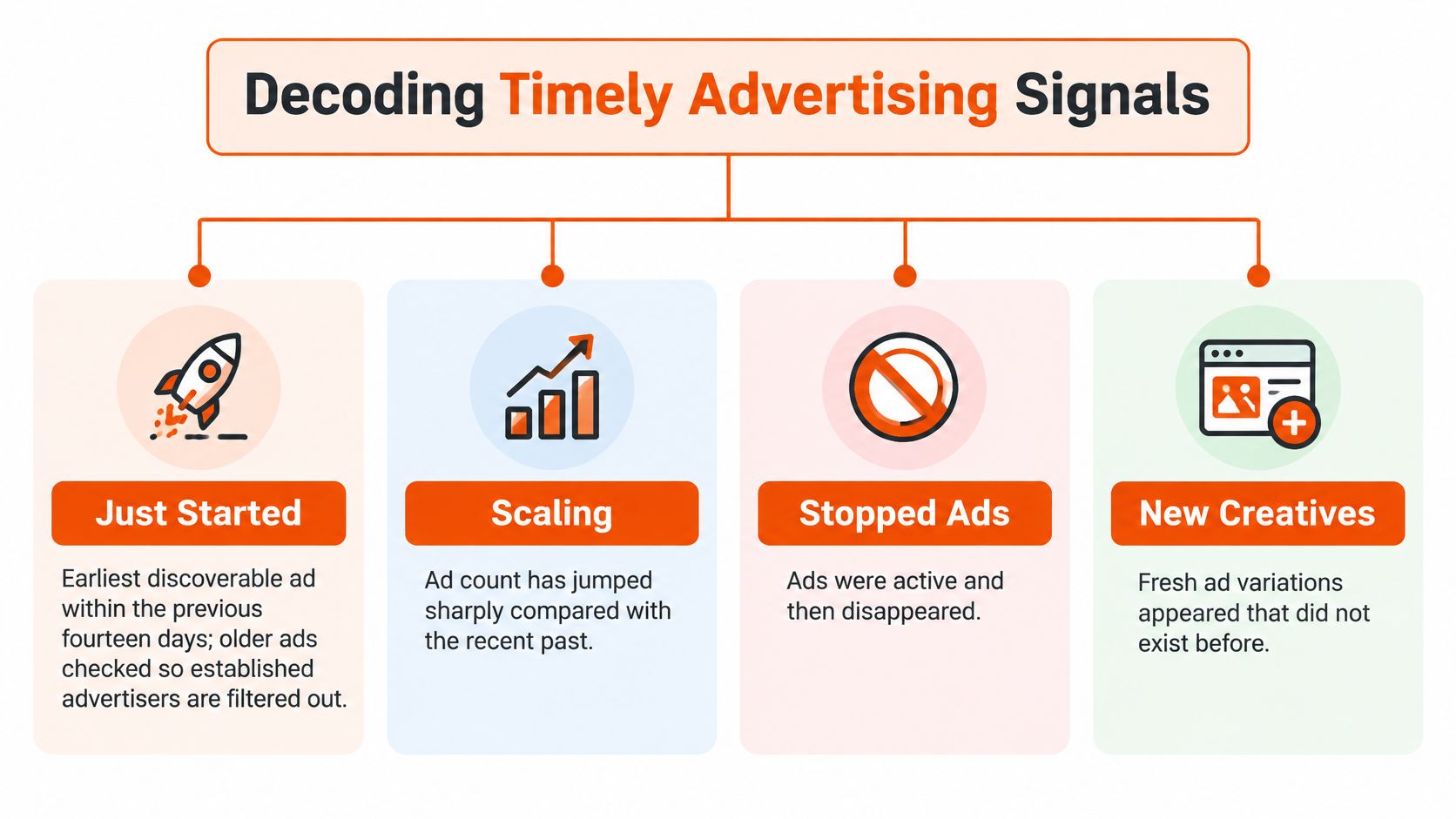
Four signal definitions do most of the work in ad-library monitoring. Just started means a brand's earliest discoverable ad appeared within the previous fourteen days, with older ads checked so established advertisers aren't misclassified as new. Scaling means active ad volume has risen sharply. Struggling means a brand launches frequently but few ads last beyond two weeks. Stopped means active ads have dropped to zero.
The chart below groups those four categories before the table adds a fifth pattern worth watching.
Timely Advertising Signals and the Problem to Pitch
| Signal | What it shows | What it does not show | Problem to pitch |
|---|---|---|---|
| Just started | An earliest discoverable ad within the previous 14 days | Profitability, budget or launch success | Launch creative, offer testing and setup |
| Scaling | A sharp increase in active ad volume | Whether return on spend holds | Creative volume, retention and measurement |
| Struggling | Frequent launches with few ads lasting beyond two weeks | The cause of the failure | Creative fatigue, landing page or offer fixes |
| Stopped | Active ads falling to zero | Whether the business closed or moved channel | Re-entry offer or channel mix review |
| Growth across several channels | Spend rising on Meta and Google together | Whether attribution is accurate | Incrementality testing and first-party data setup |
Read the middle two columns together. What a signal shows tells you when to write. What it doesn't show tells you what you're not allowed to claim in that message. A scaling brand has clearly increased its ad volume, so a creative or retention pitch fits the observable facts. You can't say the brand is wasting money or scaling profitably, because ad-library data doesn't contain either answer.
The fifth row deserves special care because the obvious pitch is often the wrong one. When a brand grows across Meta and Google at the same time, the commercial problem may be measurement rather than more media buying. That's the context for Google's 2025 measurement updates, where advertisers using its first-party-domain tag gateway received 11% more signals. If channel growth is fragmented and the brand can't tell which touchpoints drive conversions, incrementality testing or first-party data work is the more credible offer.
You can inspect the underlying ads yourself with the Facebook Ad Library scraper, which fits the manual version of this process. The automated version depends on daily scans of the Meta Ad Library and Google Ads Transparency Center. Every landing domain we see in those ads gets a store check using Shopify's /products.json endpoint and response headers, then markers on the homepage. That same check reads the tracking pixels on each store's homepage, which is how we see other ad channels beyond the one where the ad appeared.
Coverage has a clear boundary. We cover US brands only, so absence from the data says nothing about a brand outside that market.
A signal tells you when to reach out and which problem to lead with. It never tells you whether the brand will buy.
Qualifying Prospects Beyond the Ad Signal
An active advertiser is a starting point, not a qualified lead. This is the step agency owners most often skip, because a rising ad count feels like momentum and momentum feels like demand for help. Slow down there. Public ad activity shows behavior. It doesn't show whether anyone inside the brand owns a budget, wants a new provider, or is unhappy with the team they already have.
The economics explain why that caution matters. A 2025 survey cited in the MageLoyalty direct-to-consumer marketing guide put average ecommerce customer-acquisition cost at $68 to $84, reportedly 40% to 60% above 2023 levels, while median ROAS was 2.04. A brand can advertise more and still operate on thin margins, so more activity doesn't automatically mean more capacity to hire you.
Run these five checks in order. Each one includes a sign that should disqualify the brand for now.
Five Qualification Checks
- Persistence: Do launches survive beyond two weeks, or is the brand constantly replacing ads? Surviving ads suggest something is working well enough to keep running. Disqualify a media-buying prospect if nothing persists and you can't identify a fixable cause, because you'll inherit a problem you haven't diagnosed.
- Channel mix: Is growth on Meta only, Google only, or both? A single-channel brand may need creative depth or a second channel. A brand growing on both may need measurement help first. Disqualify the prospect if your service targets a channel the brand clearly isn't using and shows no sign of entering.
- Post-click quality: Judge the landing page and offer before pitching traffic. Slow pages, unclear pricing, and weak product pages can make good ads look bad. Disqualify a pure media-buying pitch if the destination page is broken, mismatched with the ad, or missing a clear offer, and consider whether you're looking at a CRO prospect.
- Operational capacity: Look for hiring activity, a team large enough to manage a provider relationship, and a product range that needs more creative or support. Disqualify the brand if it appears to be a one-person operation with a single product and no signs of capacity to act on your work.
- Fit: Confirm the brand's likely problem matches what you sell. A scaling brand with persistent ads suits a retention agency. A struggling brand with short-lived ads suits a creative testing offer. Disqualify the prospect if the most plausible problem falls outside your service, even when the timing signal is strong.
One contrarian idea is worth testing in your own pipeline. Brands with repeated launches that fail to persist aren't automatically poor prospects. They may be facing creative fatigue, conversion friction, or a testing problem, which makes them strong candidates for CRO and creative services even though they look weak as media-buying leads.
Before you approach any individual domain, you can sanity check it through a brand lookup and then apply the screens below. The first three values come from the Whatagraph PPC benchmarks, a benchmark covering more than 18,000 ecommerce brands. Treat every number here as a directional screen rather than a guarantee, because conversion definitions and attribution windows vary between accounts.
Reference Values for Screening Prospects
| Metric | Reference value | How to use it as a screen |
|---|---|---|
| Google Ads click-through rate | 1.51% | Flag accounts well below this for creative review |
| Google Ads conversion rate | 3.22% | Compare post-click results against this before pitching media buying |
| Google Ads return on ad spend | 3.31 | Treat as a directional screen, not a guarantee |
| Ecommerce customer acquisition cost, 2025 survey | $68 to $84 | Shows why spending more can still mean thin margins |
| Median ROAS, 2025 survey | 2.04 | Close to break-even after product, shipping and overhead |
Use the table to choose the pitch, not to rank brands as winners or losers. A brand generating clicks but converting poorly against the reference range is a stronger CRO or creative prospect than a media-buying prospect. A brand converting reasonably while its ad volume climbs is a more natural retention or measurement conversation.
Finish with a written scoring habit. Pursue brands that score well on fit and persistence, and write down what the ad data can't show, such as budget, margins, or an incumbent agency. That written unknown keeps your first call focused on questions instead of assumptions.
A Worked Example of Pitching a Scaling Brand
Say a hypothetical home-goods store launches eight new Meta ads in one week and its active ad count triples. This is an illustration, not a real brand. It shows how a paid social agency should reason before writing a single outreach line.
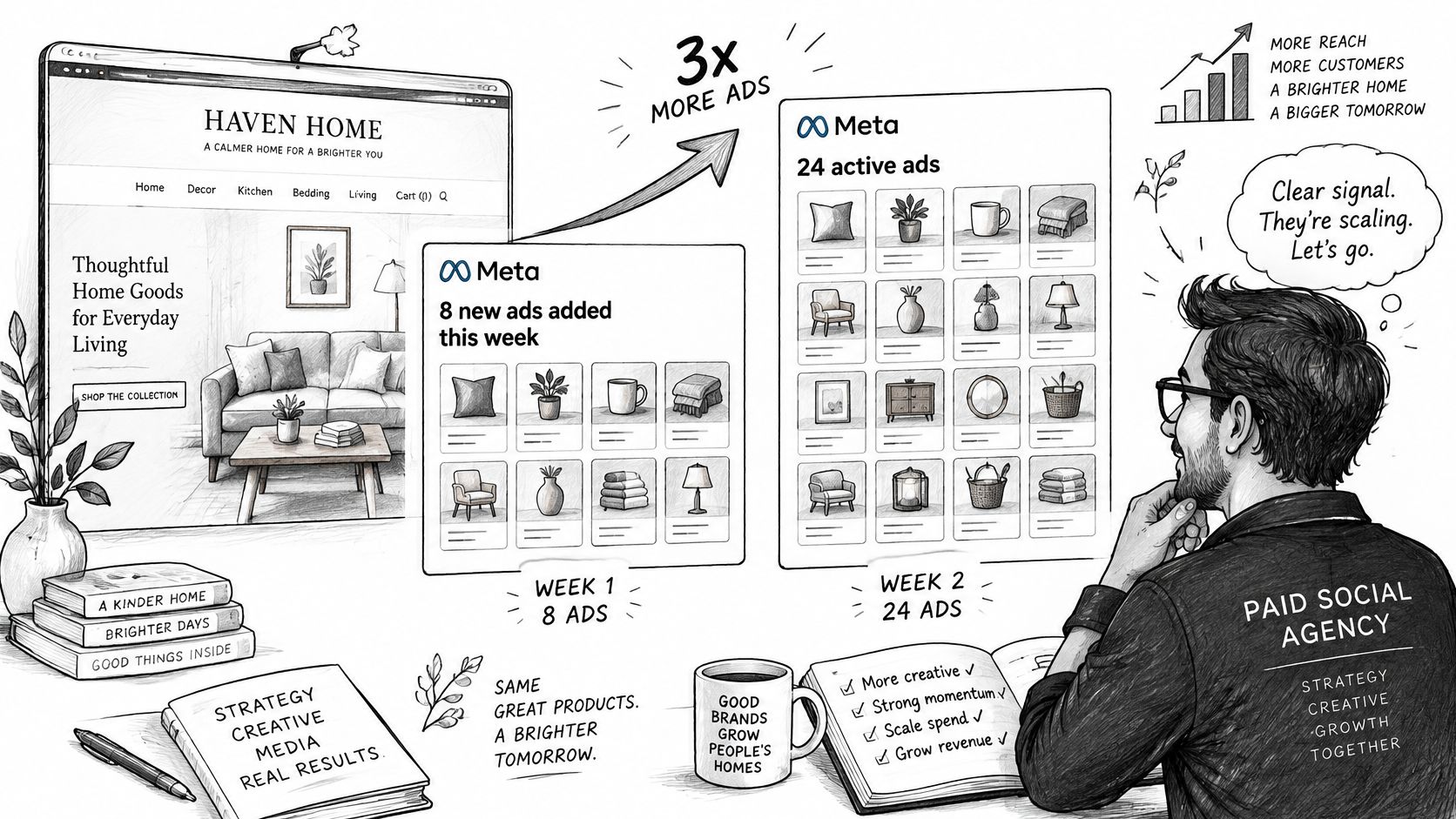
The volume jump puts the brand in the scaling category, and the next step is deciding what that jump means. An ad going live is a timing event, a moment when the brand chose to spend. It is not yet evidence that the spend is working. So the first check is persistence. If most of the eight ads are still running after two weeks, the brand has probably found concepts worth keeping, and its problem is likely to become creative supply. Sustained advertising burns through assets quickly through fatigue, so a growing active count creates recurring demand for new hooks, formats, and variations.
Next, run the qualification checks against the store itself. The homepage pixels show whether growth is Meta only or spread across channels. The landing pages show whether the offer matches the ads. The product range shows whether there is enough catalogue depth to support ongoing creative production. In this scenario, assume the pages are solid, the range is broad, and the ads persist. That combination points to one specific bottleneck. The brand needs more tested creative than it can comfortably produce.
The benchmark behind that pitch is concrete. The Benchmarketing ecommerce Meta ads benchmark reports that ecommerce advertisers running dedicated creative-testing programs, typically introducing three to five new concepts weekly, outperformed static-creative programs by 40% to 80% on ROAS. The same source recommends assigning roughly 20% to 30% of Meta spend to testing and evaluating each test only after at least 1,000 impressions. Keep the workflow clean too. Test one control against one hook variant and one format variant, then record CTR, conversion rate, CPA, and ROAS by concept.
That makes a UGC studio a natural second pitch for this brand. The agency can offer a structured testing program, while the studio supplies the raw volume of creator-led concepts the program requires. Neither pitch depends on claiming the brand is profitable. Both rest on observable behavior, a rising ad count that persists.
A pitch sentence for the home-goods store could be: "Your active ad count has roughly tripled this month, so we help brands at that stage keep three to five fresh concepts in test each week without slowing your winners down."
Now contrast a hypothetical skincare brand with repeated launches and few ads surviving beyond two weeks. More media buying is the wrong lead offer there, because the observable pattern points to something failing early. The cause could sit in the creative, the offer, or the landing page, and your message should admit you are offering to find out.
Its pitch sentence could be: "Several of your recent ads stopped within two weeks, so we run a short creative and landing page diagnostic to find whether the hook, the offer, or the page is cutting them short."
Both brands advertise actively. Only the signal pattern tells you which problem to lead with, and the offer must match the problem the signal implies.
Misconceptions That Waste Outreach Time
The most expensive mistake is assuming a new ad means a new budget. A launch shows that advertising began. It doesn't show how much budget the brand controls or who controls it, so confirm budget ownership before you propose a retainer. Agencies burn weeks building proposals for contacts who were never able to say yes.
Four misconceptions account for most of that wasted effort.
- A new ad means a new budget. The correction is above, and the consequence of ignoring it is a polished proposal presented to someone without spending authority. Ask who owns the growth budget early, in plain terms.
- The store list includes contact details. It doesn't. We don't include contact details, and brands can be exported to CSV so you can find the right person with tools such as Clay or Apollo. Plan that enrichment step into your process instead of discovering the gap mid campaign.
- Every Shopify store is covered. The Shopify store counts cover only the niches we track, not every store on Shopify. A missing brand isn't evidence that the brand is absent from the market or inactive. It may sit outside the tracked niches.
- Stopped ads mean the business has closed. The brand may have paused, shifted budget to another channel, or hit a seasonal gap. Open with a re-entry offer or a channel mix review rather than assuming failure, which also keeps your tone respectful if the business is healthy.
The coverage boundaries are equally plain. The data covers US brands only, and ad classifications can't verify sales, profitability, or financial condition. If your target market or your underwriting needs go beyond that, this type of data is a prospecting input, not a complete answer.
On compliance, customers may use exported data to research and contact brands for their own business. That permission doesn't replace local law, so check the privacy and anti-spam rules in each market you contact before you send anything.
Build Your First Prospect List This Week
A useful prospect list comes from a repeatable weekly routine, not a one-time data download. Keep the first version deliberately small. One signal, one matching service, and one saved search will teach you more in a month than a broad list you never review.
The checklist below condenses the setup before the detailed routine.
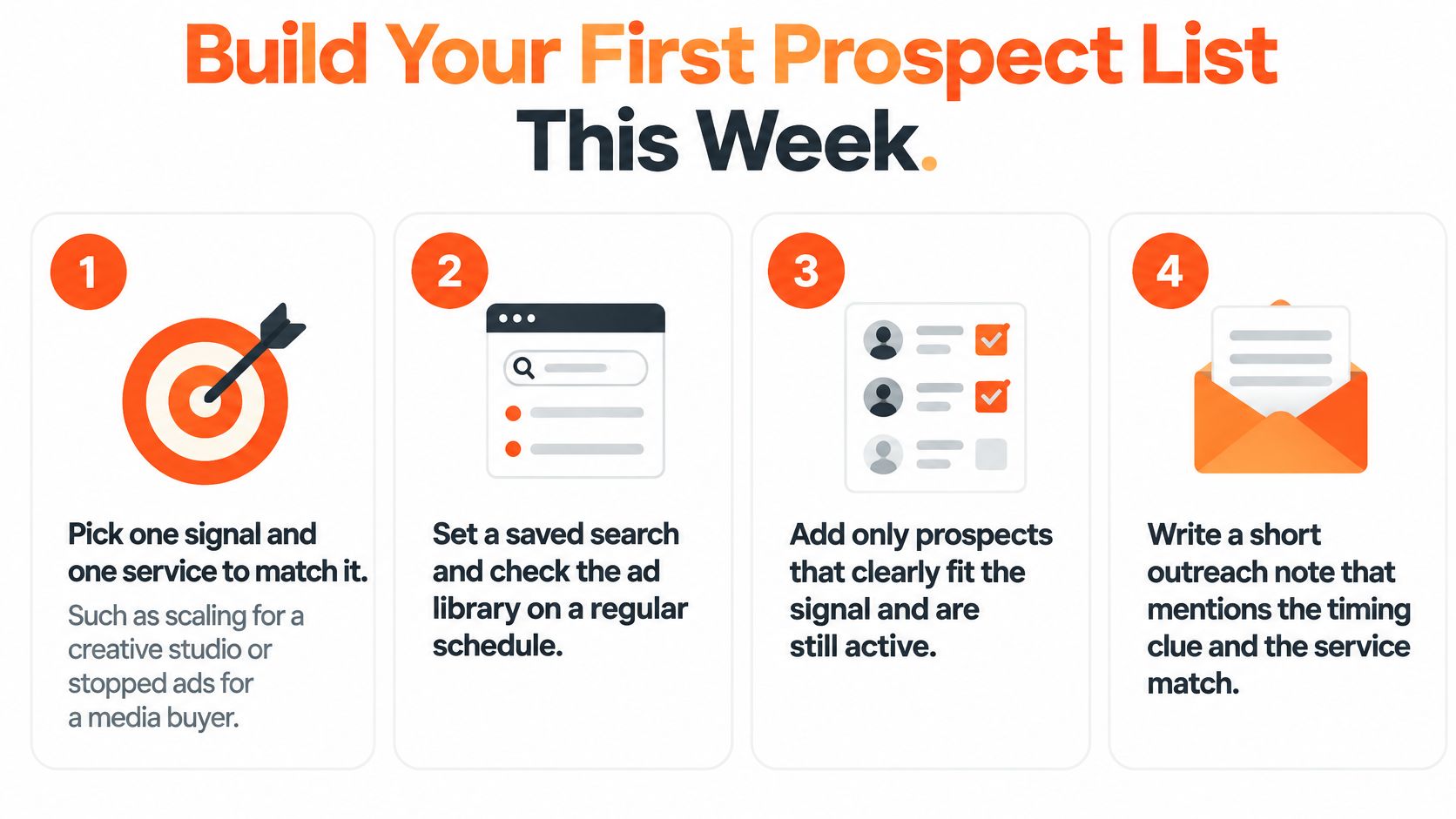
A Seven-Step Weekly Routine
- Pick one signal and one service. Match scaling to a creative studio offer or stopped ads to a media buyer's re-entry service. Narrow scope makes your results readable.
- Set a saved search. Signals can be combined with niche, ad volume, store platform and channels, and any search can be saved as an alert, so build from a targeted view such as Shopify stores running Facebook ads and let new matches come to you.
- Review each new brand against the five qualification checks. Persistence, channel mix, post-click quality, operational capacity, and fit should all get a quick pass before a name joins your outreach list.
- Write down what the ad data can't show. Note unknowns like budget, margins, or an incumbent agency next to each brand. Your first conversation should answer those questions, not pretend they're settled.
- Find the right contact with a separate enrichment tool. Export the brand records and use a tool such as Clay or Apollo to identify the person who owns growth or marketing.
- Write one pitch line tied to the signal. A re-entry offer fits a stopped brand. A creative testing offer fits a scaling one. If the line could be sent to any store, it isn't finished yet.
- After four weeks, track replies by signal type. Keep the signals that produce conversations and drop any signal that never converts, however interesting it looks on paper.
If you want the routine to run on daily alerts rather than manual checks, the Pro plan includes every brand with full ad history across 3 niches, up to 5 saved searches with daily alerts by email, Slack or webhook, and CSV export up to 2,500 rows a month. That capacity suits the review cadence above without turning prospecting into a daily manual search.
Close the loop with a fixed weekly review of the list. That habit keeps your ecommerce lead generation tied to current signals instead of drifting back toward a static list that ages a little more every week.
If you want prospecting built around dated advertising events instead of static store records, AdvertiserLeads tracks US ecommerce brands that have just started, scaled, struggled with, or stopped their Meta and Google ads, with saved searches and alerts to surface new matches as they appear. Visit the site, pick one signal that matches your service, and build your first qualified list this week.
Find brands that just started advertising
AdvertiserLeads checks the Meta Ad Library every day and flags ecom brands that just started, scaled or stopped their ads. Create a free account to see the live feed. No card.